
Reviewed · CHICAGO RIVER CRUISES
Architecture & History Guided Tour along the Chicago Riverwalk
Chicago’s riverfront packs a remarkable amount of city history into a short walk. This two-hour architecture tour links the Riverwalk with Fort Dearborn, Marina City, Tribune Tower, and several newer buildings, so you see Chicago as a city shaped by both trade and bold design.
I like the way the route mixes famous sights with less obvious stops, and I like that a local guide provides the thread between them. Kathryn, one named guide, is praised for her strong history and architecture stories. The main drawback is the brisk format: with 11 stops, some visits last only five minutes.
In This Review
- Key points
- Why Chicago’s Riverwalk makes a smart starting point
- Fort Dearborn brings early Chicago into view
- Marina City shows Chicago’s bold side
- Tribune Tower adds a neo-Gothic turn
- Water, media, and luxury architecture along the route
- The river returns as the main character
- Jeweler’s Building and AMA Plaza complete the architectural range
- What the two-hour format means for you
- Value, meeting point, and practical planning
- Who will enjoy this riverfront walk
- Should you book the Architecture and History Guided Tour?
- FAQ
- How long does the Architecture and History Guided Tour last?
- Where does the tour begin?
- What time does the tour start?
- Where does the tour end?
- Is the tour offered in English?
- Is a mobile ticket available?
- How many people can join the tour?
- Is a professional local guide included?
- Are admission tickets to the stops included?
- Can I cancel for a full refund?
Key points
- Chicago’s river tells the city’s story: Learn how a working waterway became a public riverfront destination.
- Fort Dearborn adds military history: The tour reaches the grounds tied to Chicago’s early military past.
- Marina City gets two looks: You see the famous cylindrical towers from more than one point along the route.
- The route spans old and new Chicago: Tribune Tower, the Jewelers Building, St. Regis Chicago, and AMA Plaza create a useful architectural timeline.
- The group stays small: A maximum of 18 people makes it easier to hear the guide than on a large city walk.
- The walk ends near Centennial Fountain: The final point is at Nicholas J. Melas Centennial Fountain, not back at the starting point.
Why Chicago’s Riverwalk makes a smart starting point
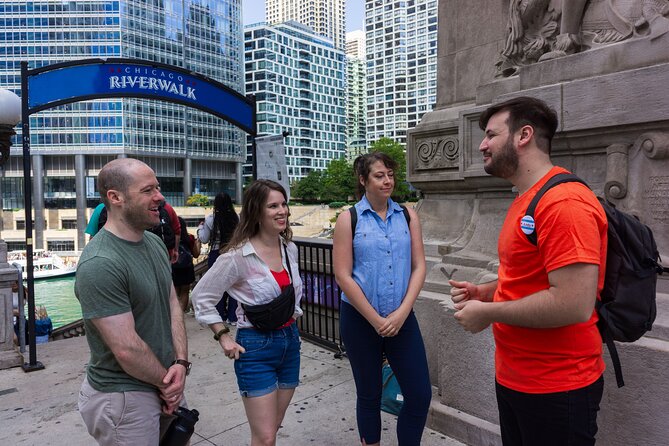
Chicago’s river is more than a scenic strip beside downtown towers. It has been a center of trade and commerce since the late 1700s, and this tour uses that fact as its opening idea. You begin at 1 W Wacker Dr at 10:00 am, then follow the riverfront while the guide explains how the waterway helped shape the city.
That setting gives the tour a clear purpose. Instead of looking at buildings one by one, you can connect architecture to the river’s working role. The route also shows how the riverfront has changed into a place for public walks, views, and city celebrations.
The first stop lasts about 20 minutes, with no admission ticket required. That is enough time to get your bearings, hear the main story, and begin noticing the contrast between the water, older stone buildings, and modern towers.
I would arrive ready to walk and look upward. The experience is built around outdoor observation, not interior visits, so the quality of the tour depends on the guide’s explanation and your attention to the buildings around you.
More cruises along the Chicago River:
- Chicago Architecture River Cruise
★ 5.0 · 15,756 reviews - Chicago River 90-Minute Architecture Tour
★ 4.5 · 9,629 reviews - Chicago River: 1.5-Hour Guided Architecture Cruise
★ 4.8 · 8,046 reviews
Fort Dearborn brings early Chicago into view
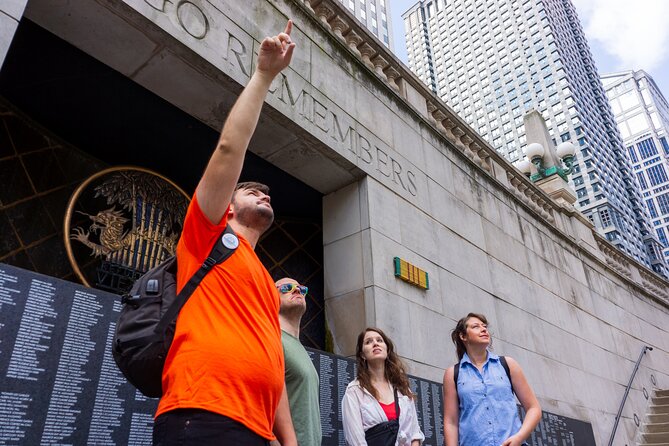
The second stop shifts from public waterfront design to military history. At the grounds connected with the Battle of Fort Dearborn, the guide places Chicago’s early past in a real location rather than treating it as a date on a timeline.
You get about 20 minutes here. That makes this one of the fuller stops, alongside the opening Riverwalk section and Marina City. The military connection gives the tour a useful change of pace. Chicago can seem like a city of steel, offices, and commerce, but Fort Dearborn points to an earlier period when the area’s story was also tied to military presence and conflict.
The supplied tour details do not promise entry into a museum or surviving fort structure. Plan on an outdoor stop with historical interpretation. If you like architecture tours that include civic history, this part adds needed context. If you want a long, detailed military-history program, the 20-minute visit will feel more like an introduction.
Marina City shows Chicago’s bold side
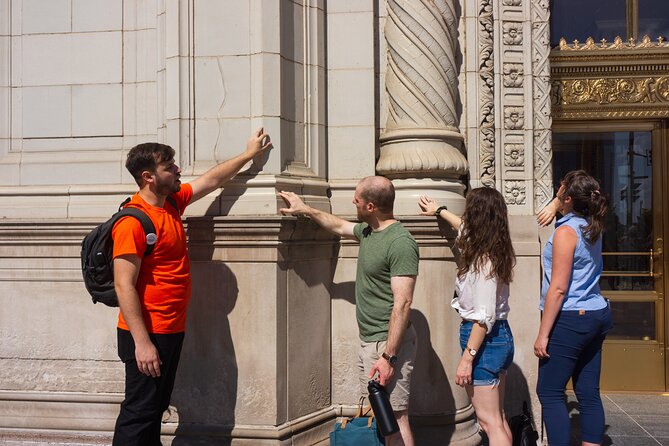
Marina City receives special attention, and rightly so. The pair of cylindrical residential towers is widely known by the nickname corn cobs, a description that makes sense as soon as you see their rounded form rising beside the river.
The tour includes a 20-minute Marina City stop and later returns for another five-minute look. That repeat is useful. You get time first to understand the buildings as part of the riverfront, then another chance to study their shape and position from a different point.
I like this part because it gives you a clear example of Chicago’s willingness to make housing architecture visually daring. The towers are not simply background scenery. They help explain why the city is so closely linked with modern architectural ideas.
Still, do not expect a long interior visit. The details provided describe outdoor exploration of the structures, not access inside the residential buildings. Bring your own interest in form, scale, and river views, and you will get more from the stop.
Tribune Tower adds a neo-Gothic turn
After the rounded forms of Marina City, Tribune Tower offers a sharp change in mood. The building is described as a neo-Gothic masterpiece and served as a home for the Chicago Tribune newspaper.
The stop lasts about five minutes, so the guide will likely focus on the building’s main visual and historical points. That short timing can work well if you want a broad tour of downtown architecture. You get to place the tower within a larger story without spending the whole morning on a single building.
I would pay close attention to the contrast here: Marina City is cylindrical and modern, while Tribune Tower looks back to Gothic design. That side-by-side comparison is one of the pleasures of this route. You are not just collecting famous addresses. You are seeing how different ideas about power, journalism, housing, and civic identity appear in stone and concrete.
Because the stop is brief, you may want to continue looking at the tower as the group moves on. The tour provides the guide’s context, but it is not designed as an extended façade study.
More architecture tours in Chicago:
- Chicago Architecture Center River Cruise aboard First Lady
★ 5.0 · 5,536 reviews - Chicago: Architecture River Cruise Skip-the-Ticket Line
★ 4.8 · 4,325 reviews - Chicago River 45-Minute Architecture Tour from Magnificent Mile
★ 4.5 · 2,924 reviews - Chicago Lake and River Architecture Tour
★ 4.5 · 2,308 reviews
Water, media, and luxury architecture along the route
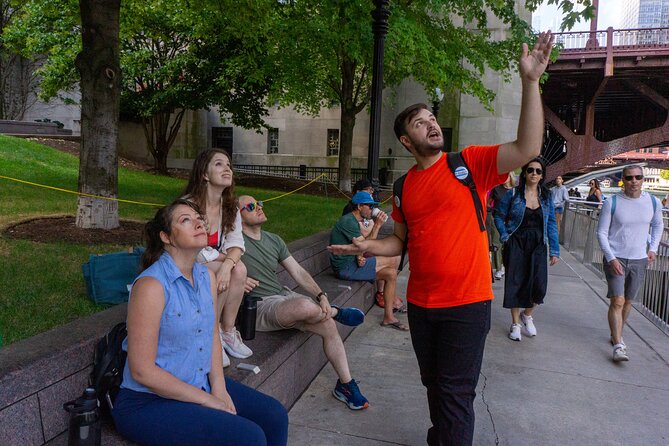
The next group of stops broadens the architectural mix. Centennial Fountain and Water Arc takes about five minutes and commemorates important milestones in Chicago’s history. Its cascading water gives you a visual break from façades and towers.
The fountain is also the end point of the tour, although it appears earlier in the route as a stop. The listed ending location is Nicholas J. Melas Centennial Fountain at 400 N McClurg Ct. That means the fountain serves both as an architectural feature during the walk and as a practical place to finish.
The St. Regis Chicago represents one of the city’s newer luxury additions. The tour does not promise entry, so you will be looking at the building as part of the changing riverfront. Its inclusion helps you see that Chicago architecture is not only a historic subject. New construction continues to shape the river corridor.
At 455 Cityfront Plaza Dr, you examine an Art Deco-inspired modern media center. This is a particularly useful stop if you want to compare historical references with contemporary design. The building is modern, but its style draws on an older decorative language.
Each of these visits lasts about five minutes. That is enough for a concise explanation and a quick look, but not enough for a lengthy discussion. I see this as a strength for an introductory walk and a limitation for anyone who wants technical architectural analysis.
The river returns as the main character
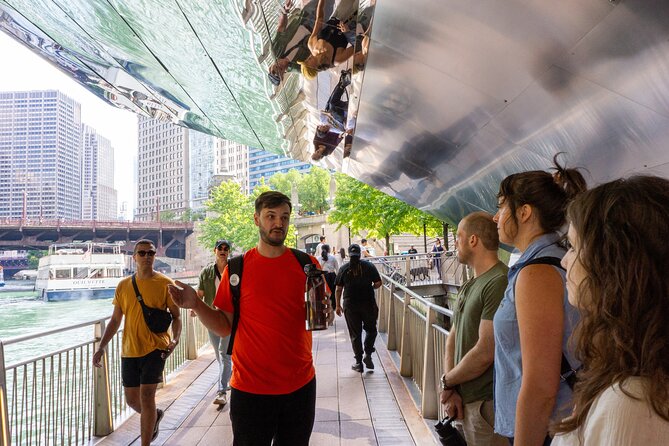
The route includes another 10-minute stop along the Chicago River. Here, the guide returns to the waterway’s role in the city’s development and gives you time to enjoy the river views.
This second river stop matters because the buildings make more sense when you step back from them. From the water’s edge, you can see how the river connects old commercial Chicago with newer residential, media, and luxury projects.
I appreciate the repeated return to the river. A less focused tour might treat the water as a pretty backdrop. This one uses it as the main organizing idea. The river explains why the route is here, why the buildings face this direction, and why the downtown waterfront has become such a popular public place.
The tour’s outdoor nature also means your experience can depend on the day’s conditions. The provided details do not list weather arrangements, indoor alternatives, or a covered route. Dress for a two-hour city walk and do not assume you will spend much time inside.
Jeweler’s Building and AMA Plaza complete the architectural range
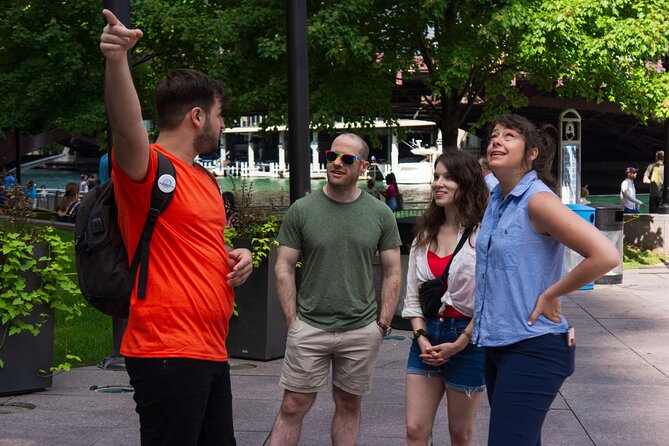
The Jewelers Building is another five-minute stop. Its past connection with Chicago’s diamond district gives the tour a commercial angle, just as Fort Dearborn supplies a military angle and Tribune Tower supplies a newspaper connection.
That range is one of the tour’s best features. You are not only hearing about architects. You are seeing how buildings supported different parts of city life, including trade, media, housing, luxury development, and public space.
The final listed architectural stop is AMA Plaza. Its minimalist design comes from one of the pioneering masters of modern architecture. The supplied details do not name the architect, so the guide’s explanation will be important if you want the full story behind the building.
The five-minute timing keeps the walk moving. You will get a concise introduction rather than a seminar. I would treat AMA Plaza as a final example in the tour’s visual sequence: neo-Gothic Tribune Tower, cylindrical Marina City, Art Deco-inspired media architecture, newer luxury design, and minimalist modernism.
What the two-hour format means for you
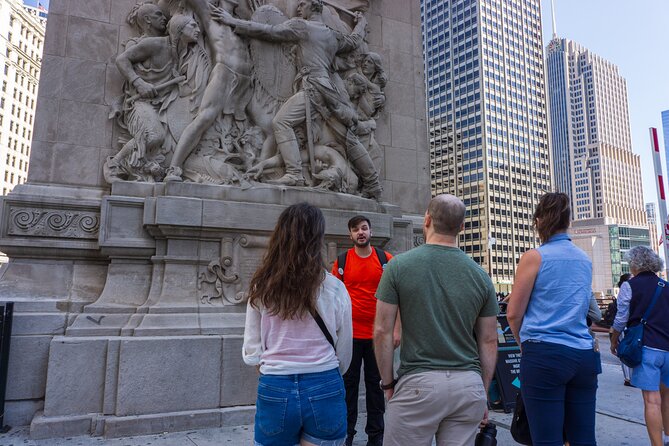
The tour lasts about two hours and includes 11 listed stops. That is a lot of ground for a morning walk, especially when several stops last only five minutes.
The schedule suggests a survey course rather than a single-building study. Three stops receive 20 minutes each: the Chicago Riverwalk, Fort Dearborn, and Marina City. The river receives 10 minutes, while most buildings and the fountain receive five minutes.
That pacing works best if you want orientation. You can learn what to notice, identify places worth revisiting, and gain a broad sense of Chicago’s architectural range. It is less suitable if you prefer to linger, sketch, take long photographs, or ask detailed questions at every stop.
The group maximum is 18 people. That is small enough to make a local guide’s commentary more personal than it would be in a large bus group, while still being large enough that you should stay close and listen carefully at busy riverfront points.
The tour is offered in English and includes a professional local guide. The guide is the central value here. Kathryn is specifically praised for making Chicago’s history and architecture informative, so if she leads your walk, you can expect a strong focus on explanation rather than simply pointing out buildings.
Value, meeting point, and practical planning
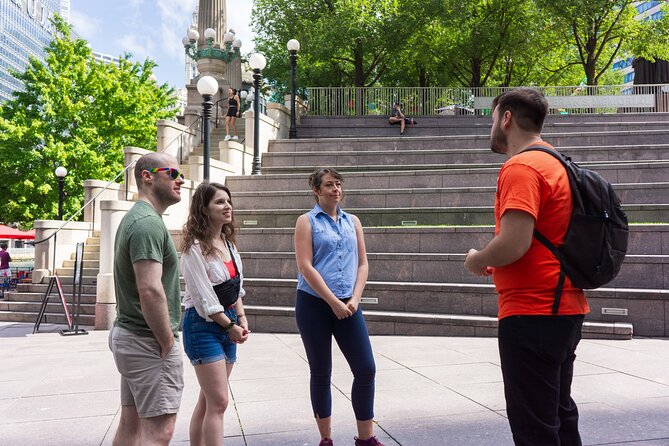
No admission tickets are required for the listed stops. That keeps the financial value straightforward: you are paying for the guide, the route, the historical context, and the convenience of having the major sights connected in one walk.
I think the value is strongest for a first visit to Chicago or for anyone who wants an organized introduction to downtown architecture. You could walk by many of these buildings on your own, but you would need to research their stories and work out the sequence yourself. The tour saves that effort and gives the riverfront a clear narrative.
The meeting point is 1 W Wacker Dr, Chicago, Illinois 60601, with a 10:00 am start. The walk ends at Centennial Fountain, 400 N McClurg Ct, Chicago, Illinois 60611. Since the start and end points differ, plan your next activity from the endpoint rather than expecting to return to Wacker Drive.
The tour is near public transportation, and service animals are allowed. Most people can participate, according to the supplied accessibility information. Specific details about surface conditions, seating, restroom breaks, and wheelchair access are not provided, so you should confirm those points directly if they matter for your plans.
Mobile tickets make arrival simple. Confirmation is provided at booking. Free cancellation is available if you cancel at least 24 hours before the start time. Inside that 24-hour window, the payment is not refunded and changes are not accepted.
Who will enjoy this riverfront walk
I would choose this tour if you like history with your architecture. Fort Dearborn, the river’s trade story, the Jewelers Building, and Tribune Tower give the walk more depth than a simple list of impressive façades.
It also suits you if you want a manageable introduction before exploring Chicago on your own. The guide points out a useful set of landmarks, and the repeated river stops help you understand the area’s layout.
Families and mixed-interest groups may find the varied route helpful. The story moves from military history to residential towers, journalism, luxury construction, media design, public fountains, and modern minimalism. No single subject dominates for too long.
I would hesitate if you want interior access, a long photography session, or a highly technical lecture. The tour is outdoors, the schedule is tight, and the provided details do not include building entries.
Should you book the Architecture and History Guided Tour?
Book it if you want a focused two-hour introduction to Chicago’s riverfront, especially if you value a guide who can connect city history with building design. The strongest reasons are the well-chosen mix of stops, the return to Marina City, the river-centered route, and the small maximum group of 18.
Skip it if your main goal is to enter buildings or spend half an hour at each landmark. For most first-time visitors, though, this is a practical way to get the downtown story in one morning. The perfect finishing touch is the walk’s endpoint at Centennial Fountain, where you can continue exploring the riverfront after the guide says goodbye.
FAQ
How long does the Architecture and History Guided Tour last?
The guided walk lasts approximately two hours.
Where does the tour begin?
The tour begins at 1 W Wacker Dr, Chicago, Illinois 60601, USA.
What time does the tour start?
The listed start time is 10:00 am.
Where does the tour end?
The tour ends at Nicholas J. Melas Centennial Fountain, 400 N McClurg Ct, Chicago, Illinois 60611, USA.
Is the tour offered in English?
Yes. The tour is offered in English.
Is a mobile ticket available?
Yes. The experience includes a mobile ticket, and confirmation is provided at the time of booking.
How many people can join the tour?
The maximum group size is 18 people.
Is a professional local guide included?
Yes. A professional local tour guide is included. Kathryn is one guide associated with the experience.
Are admission tickets to the stops included?
The listed stops have no admission ticket charge. The experience is a guided outdoor walk along the riverfront.
Can I cancel for a full refund?
Yes, if you cancel at least 24 hours before the experience start time. Cancellations made less than 24 hours before the start time are not refunded, and changes within that period are not accepted.
More History Walks in Chicago
- Chicago in a Day: Food, History & Architecture Walking Tour
★ 5.0 · 1,153 reviews - Chicago: Field Museum of Natural History Ticket or VIP Tour
★ 4.7 · 717 reviews - Field Museum of Natural History Admission Tickets
★ 4.5 · 489 reviews - Chicago Walking Tour: Historic Treasures of Chicago
★ 5.0 · 362 reviews
Just added in Chicago
- Chicago: Architecture and Engineering Marvels Walking Tour★ 5.0 · 3 reviews
- Private Downtown Chicago TV and Movie Sites Guided Walking Tour★ 4.5 · 3 reviews
- Black Heritage Tour★ 5.0 · 3 reviews
- Private SUV Transfer from Chicago Downtown to Midway airport★ 5.0 · 3 reviews
- Private Holiday City Tour★ 5.0 · 3 reviews
- BYOB Chicago River Guided History Tour★ 5.0 · 4 reviews
- Chicago 4-Hour Sightseeing Transfer by Luxury SUV★ 4.5 · 3 reviews
- Chicago, Cloud Gate, Grant Park Full-Day City Tour★ 4.0 · 4 reviews
Chicago River Cruises, compared.
Chicago Architecture Center River Cruise aboard First Lady
Read our review →
Architecture River Cruise Skip-the-Ticket Line
Read our review →
Chicago River 45-Minute Architecture Tour from Magnificent Mile
Read our review →
45-Minute Family-Friendly Architecture River Cruise
Read our review →Browse the lists this tour appears in