
Reviewed · ART INSTITUTE OF CHICAGO TOURS
Art Institute of Chicago Private Expert Guided Tour
The best reason to book this tour is simple: the Art Institute of Chicago is too large for a casual two-hour wander. A private guide helps you find the important rooms, understand what you’re looking at, and adjust the route to your interests. Guides including Joe, Colleen, Marlin, Brian, Mark, Michelle, Heath, and others bring different backgrounds and personalities to the experience.
I like the private format, which lets you ask questions without holding up a group. I also like the all-day admission, reported by the operator as available after the guided portion, so you can leave for lunch and return to see more on your own. The main consideration is price: at $215 per person, this is a serious splurge, especially for a short visit.
In This Review
- Key points at a glance
- Why a private guide helps at the Art Institute
- What the two-hour route usually covers
- Hartwell Memorial Window by Tiffany Studios
- Caillebotte and Seurat in Paris
- Van Gogh’s The Bedroom
- Georgia O’Keeffe’s Sky Above Clouds
- Hopper’s Nighthawks
- Ivan Albright’s A Picture of Dorian Gray
- Grant Wood’s American Gothic
- Chagall, Picasso, Warhol, and Pollock
- The guide makes the difference
- A private pace, not a private museum
- Is $215 per person good value?
- Who should book it?
- How to get more from your two hours
- Should you book the Art Institute private tour?
- FAQ
- How long is the Art Institute private tour?
- Is museum admission included?
- Can I choose which artworks to see?
- Is the tour private?
- Where does the tour meet?
- Is the tour wheelchair accessible?
Key points at a glance
- Private two-hour route: Your group gets the guide’s full attention, with room to change the focus and pace.
- Skip-the-line entry: Entrance fees are included, and morning tours offer early admission.
- Major works in one visit: The usual route can include Van Gogh, Seurat, Caillebotte, Hopper, Wood, Picasso, Warhol, and more.
- Stories behind the paintings: Guides explain artists, techniques, historical setting, and sometimes how works reached Chicago.
- Good for mixed-interest groups: Families, couples, and art beginners can all shape the visit around their own questions.
- Useful all-day ticket: After the tour, you can continue independently, leave for lunch, and return later that day.
Why a private guide helps at the Art Institute
The Art Institute of Chicago can feel like several museums joined under one roof. You have European paintings, American art, modern and contemporary works, decorative arts, textiles, photography, and more. Even a full day can leave you wishing for a map and a plan.
That is where this tour earns its keep. Instead of spending your first half hour working out where the famous paintings are, you meet at 111 Michigan Avenue and begin with a guide who already knows how to connect the collection. You can ask for broad context, focus on a particular artist, or simply follow the major works.
I especially like this approach for people who do not normally visit art museums. A guide can explain why a painting matters without assuming that you already know the vocabulary. You can ask the obvious question, the technical question, or the slightly awkward question about why a famous work looks the way it does.
The private setting also works well for a family with different attention spans. A 10-year-old may want the story behind American Gothic, while a parent may care more about Van Gogh or Picasso. The guide can shift gears rather than deliver one fixed speech to everyone.
More at the Art Institute:
- Skip-the-line: Art Institute of Chicago Guided Tour
★ 5.0 · 417 reviews - Private Art Institute of Chicago Skip-the-Line Guided Tour
★ 5.0 · 275 reviews - Skip the Line Art Institute of Chicago Tour Semi-Private 8ppl Max
★ 5.0 · 157 reviews
What the two-hour route usually covers
The precise path can change. Paintings may be on loan, under restoration, or temporarily moved, so no specific work is guaranteed. Still, the usual selection gives you an excellent cross-section of the museum.
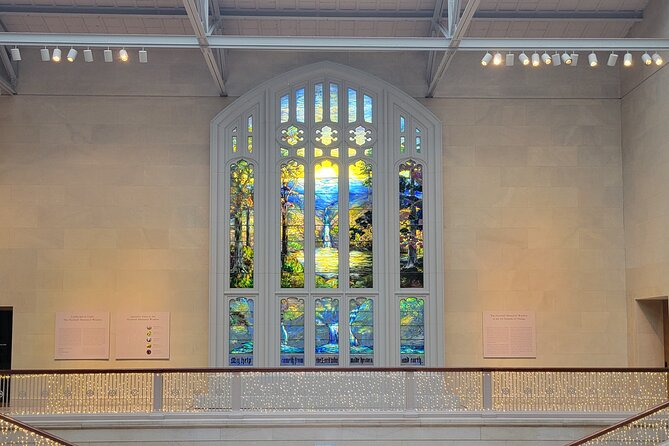
Hartwell Memorial Window by Tiffany Studios
The tour may begin with the Hartwell Memorial Window, a large work by Tiffany Studios. It gives you an early reminder that the Art Institute is not only about framed paintings. Glass, light, color, and craftsmanship all matter here.
This is a useful first stop because it broadens your idea of what counts as art in the museum. A guide can point out how the work functions as both an image and a designed object, something to be viewed in relation to light and space.
Caillebotte and Seurat in Paris
Gustave Caillebotte’s Paris Street; Rainy Day offers a dramatic look at modern city life. The broad street, wet pavement, and oddly cropped figures make the scene feel both carefully arranged and slightly accidental. You may find yourself looking at the painting as a picture of Paris, but also as a study in perspective and movement.
Georges Seurat’s Sunday on La Grande Jatte brings a very different method. Its tiny dots of color ask you to step back and let your eyes combine them, then move closer to inspect the surface. This is the kind of work that benefits from a guide because a few clear comments can turn a familiar image into a practical lesson in technique.
A few more Chicago tours worth a look before you decide
- Chicago Private Custom City Tour with Hotel Pick Up
★ 5.0 · 201 reviews - Private Arrival Transfer from Chicago Airports (ORD) (MDW)
★ 3.5 · 196 reviews - Private 45-Minute Chicago Skyline Helicopter Tour
★ 5.0 · 126 reviews - Best of Chicago: Architecture & Highlights City Private Tour
★ 5.0 · 94 reviews
Van Gogh’s The Bedroom
Vincent van Gogh’s The Bedroom is one of the museum’s best-known paintings, but familiarity can make it easy to glance at and move on. A good guide slows you down and directs your attention to the room’s tilted perspective, strong outlines, and unusual color choices.
This is also where artist context helps. You are not just seeing a bedroom. You are seeing how Van Gogh used a simple interior to create mood and tension. The guide may connect the painting to his working method and personal story, giving you more to notice than the famous name alone.
Georgia O’Keeffe’s Sky Above Clouds
Georgia O’Keeffe’s Sky Above Clouds gives the route a change of scale and feeling. Repeated clouds stretch across a large field, turning a view from above into something almost abstract.
I like this stop for visitors who think modern art is difficult or remote. The work is direct enough to enjoy at a glance, but it also raises questions about repetition, distance, and the way an artist transforms a real view. You can ask the guide to compare it with more literal paintings elsewhere in the museum.
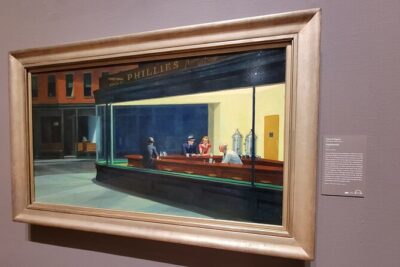
Hopper’s Nighthawks
Edward Hopper’s Nighthawks needs little introduction, yet it rewards close attention. The bright diner, dark streets, and silent figures create a scene that feels public and lonely at the same time.
The value of a guide here is not simply learning the title and date. You can look at the lighting, the missing doorway, the arrangement of the figures, and the way the glass separates the diner from the city. These details help explain why the painting has such a strong emotional pull.
Ivan Albright’s A Picture of Dorian Gray
Ivan Albright’s A Picture of Dorian Gray is a darker and more unsettling stop. The work is packed with surface detail and an almost uncomfortable attention to aging and decay.
This painting may appeal to you if you prefer art that creates a reaction rather than offering easy beauty. It also makes a strong contrast with the cleaner lines and bright color of other works on the route. A guide can help you understand how the painting relates to Oscar Wilde’s story and Albright’s intense style.
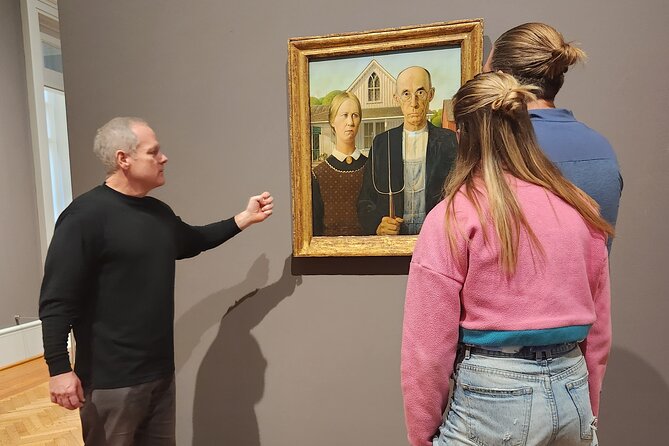
Grant Wood’s American Gothic
Grant Wood’s American Gothic is one of those paintings you may think you already know because its image has been copied and parodied so often. Seeing the original gives you a chance to examine the stiff poses, clothing, expressions, and small details without the distractions of reproduction.
The guide can explain how the painting has been read, misunderstood, and reused in popular culture. That context matters because the work is more than a stern-looking couple in front of a house. It has become part of the visual language of the United States.
Chagall, Picasso, Warhol, and Pollock
Marc Chagall’s America Windows adds bold color and a dreamlike quality to the visit. Pablo Picasso’s The Old Guitarist offers a more restrained and melancholy mood, while Andy Warhol’s Four Mona Lisas plays with repetition, celebrity, and mass production.
Jackson Pollock’s Greyed Rainbow can be a useful final test of your new museum skills. Instead of searching for a recognizable subject, you look at movement, paint, layering, and the physical act of making the picture. If abstract art has ever left you cold, this is a good place to ask direct questions.
The route can also include other major works, depending on what is available. You should treat the list as a guide to the museum’s highlights, not a firm promise of every single painting.
The guide makes the difference
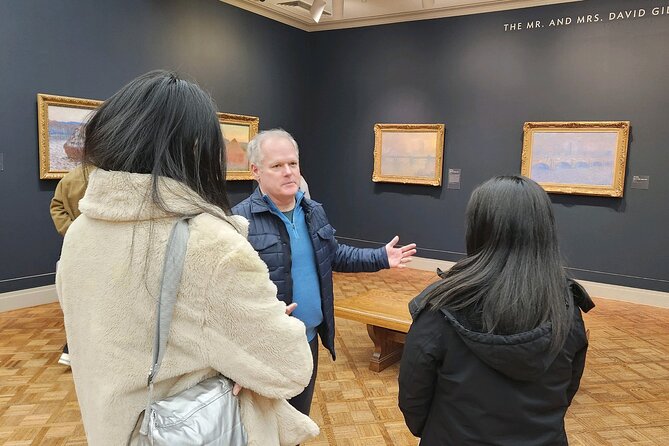
The strongest part of this experience is the human element. Joe is repeatedly praised for combining artist background with the story behind each painting. That approach turns a gallery visit into a series of connected stories rather than a parade of famous names.
Colleen’s slower pacing suits people who want time to look around each gallery while walking between stops. She also makes space for questions instead of rushing from one masterpiece to the next. Marlin is a good fit if you want a flexible route with a relaxed and personal feel.
Brian Gallagher has a useful grasp of three separate subjects: the art itself, the history of the artists, and how works came to Chicago. That last part is easy to overlook, but it gives the collection a local connection. You are not just seeing European and American art in isolation. You are also learning how a Chicago museum assembled such an ambitious collection.
Heath brings experience as a former art dealer and can place five centuries of art into a larger story about changing ideas and artistic influence. Mark and Michelle are described as personable as well as well informed, which can matter just as much as facts when you are spending two hours in close conversation.
No guide can be guaranteed by name unless your booking specifically confirms one. Still, the range of guides gives you a sense of the tour’s strengths: art knowledge, clear storytelling, patience, and the ability to adjust to your group.
A private pace, not a private museum
Private does not mean you have the galleries to yourself. You will still be visiting a major public museum, and other people will be in the rooms. What you gain is control over your own conversation, timing, and questions.
That distinction matters. A standard group tour may need to keep moving even when you want another minute with a painting. Here, you can ask to linger, request more detail, or move on when a particular work does not interest you.
The pace is usually active because the museum is large and the tour lasts only about two hours. You should not expect to see every department. Think of the guided portion as a focused introduction, followed by optional independent time if you use the all-day ticket.
Is $215 per person good value?
The $215 price makes the most sense for a small group that wants depth rather than the lowest admission cost. Since the tour is private, the guide’s attention is shared only by your party. A couple pays more per person than a larger family or group, but the flexibility can still justify the cost if art is a central part of your Chicago visit.
You are paying for more than entry. The package includes museum admission, skip-the-line access, and a two-hour private guide. Morning tours include early admission, which can be useful if you want to begin before the museum becomes more crowded.
The value improves if you plan to stay after the guided visit. One particularly useful feature is the ability to leave for lunch and return later with the same-day ticket. That turns a two-hour tour into a framework for a longer museum day.
I would not book this solely to save money or to rush through famous paintings for photographs. If you only have a short window and want a basic look at the building, regular admission may be enough. But if you want to understand what you are seeing, or need help choosing among hundreds of rooms, the private price is easier to defend.
Who should book it?
This tour suits couples who want a thoughtful cultural activity, families with mixed art interests, and first-time visitors who do not want to plan the museum alone. It is also useful for people who have visited before but missed the collection’s major works or want a better explanation of them.
Art beginners should feel comfortable here. The guide’s role is to make the paintings easier to approach, not to test you. You can ask why a work is famous, how a technique works, or what you should notice first.
Serious art fans may enjoy the chance to request particular artists or periods. The tour is customizable, so tell the guide what matters to you. You might ask for more modern art, more American painting, or a broader route across several centuries.
The tour is wheelchair friendly, service animals are allowed, and the meeting point is near public transportation. Transportation to and from the museum is not included, so you need to arrange your own way to 111 Michigan Avenue. Most people can participate, but the two-hour format still involves moving through museum galleries.
The tour is often booked about 17 days ahead. That is a useful planning clue, especially if you need a morning time or are visiting Chicago during a busy period. Free cancellation is available if you cancel at least 24 hours before the start time. Changes or cancellations inside that window are not accepted for a refund.
How to get more from your two hours
Before the tour starts, decide what kind of visit you want. Do you want the famous works, a particular artist, American art, modern art, or a balanced overview? A private guide can respond much better when you offer a clear preference.
Wear comfortable shoes and avoid trying to see the entire museum during the guided portion. Two hours is enough for a strong selection, not every gallery. Let the guide handle the route, then use the remaining admission time to revisit the works that caught your attention.
Ask about the story behind a painting, not only its date and style. The most useful explanations often involve how a work was acquired, what the artist was trying to solve, or why viewers at the time reacted to it. Joe’s behind-the-scenes explanations about how pieces reached the museum are a good example of the kind of detail that can stay with you.
If you have children, let them choose one or two works to investigate. The family format works best when young people are allowed to ask questions and make connections rather than being expected to listen quietly through a lecture.
Should you book the Art Institute private tour?
Book it if you want a focused introduction, personal guidance, and the freedom to shape the visit around your group. The combination of skip-the-line entry, a private guide, major artworks, and all-day admission makes this a strong choice for a first visit or a special occasion.
Skip it if $215 per person is beyond your budget, if you prefer to wander alone, or if you want to spend a full day exploring every department at your own pace. The tour is not a substitute for the whole museum.
For most people who want the Art Institute to feel understandable rather than overwhelming, I would book it, then keep the rest of the day open for a second look at your favorite rooms.
FAQ
How long is the Art Institute private tour?
The guided experience lasts approximately two hours.
Is museum admission included?
Yes. All entrance fees and skip-the-line museum admission are included.
Can I choose which artworks to see?
The tour can be customized around your interests and particular pieces you would like to see. Specific works can be unavailable if they are on loan or being restored.
Is the tour private?
Yes. Only your group participates in the private tour.
Where does the tour meet?
The meeting point is 111 Michigan Avenue, Chicago, Illinois 60603. The activity ends back at the meeting point.
Is the tour wheelchair accessible?
Yes. The experience is wheelchair friendly. Service animals are also allowed, and the museum is near public transportation.
Just added in Chicago
- Chicago: Architecture and Engineering Marvels Walking Tour★ 5.0 · 3 reviews
- Private Downtown Chicago TV and Movie Sites Guided Walking Tour★ 4.5 · 3 reviews
- Private SUV Transfer from Chicago Downtown to Midway airport★ 5.0 · 3 reviews
- Private Holiday City Tour★ 5.0 · 3 reviews
- Black Heritage Tour★ 5.0 · 3 reviews
- BYOB Chicago River Guided History Tour★ 5.0 · 4 reviews
- Chicago 4-Hour Sightseeing Transfer by Luxury SUV★ 4.5 · 3 reviews
- Chicago, Cloud Gate, Grant Park Full-Day City Tour★ 4.0 · 4 reviews
Art Institute of Chicago Tours, compared.
Skip-the-line: Art Institute of Chicago Guided Tour
Read our review →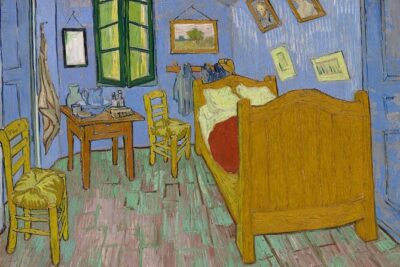
Private Art Institute of Chicago Skip-the-Line Guided Tour
Read our review →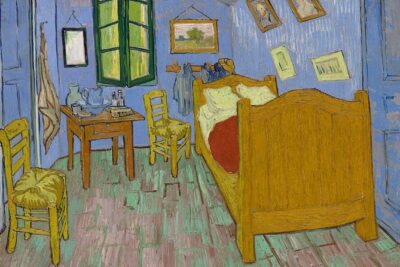
Skip the Line Art Institute of Chicago Tour Semi-Private 8ppl Max
Read our review →
Ferris Bueller Movie Tour at the Art Institute of Chicago
Read our review →Browse the lists this tour appears in