
Reviewed · ART INSTITUTE OF CHICAGO TOURS
Skip-the-line: Art Institute of Chicago Guided Tour
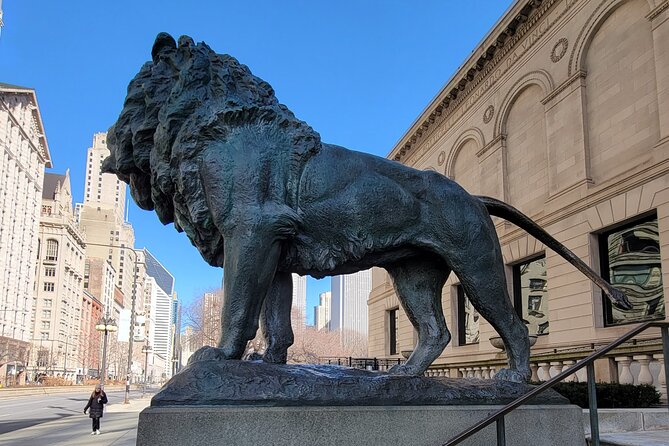
The best thing about this Art Institute of Chicago tour is its clear mission: get you to the museum’s major works before two and a half hours disappear among four floors of galleries. Guides such as Joel, Bernie, Scout, Colleen, and Arnold add stories about artists, Chicago, and the museum’s collection rather than leaving you to hunt for the famous paintings on your own.
I like the small group of 12 or fewer, which gives you room to ask questions and makes it easier to hear the guide. I also like the mix of familiar icons, from Van Gogh’s The Bedroom to Hopper’s Nighthawks, with less obvious but memorable works such as Ivan Albright’s A Picture of Dorian Gray.
The tradeoff is pace. You see a lot in 2 hours and 30 minutes, but you will not have much time to linger at every painting. This is a guided highlights tour, not a slow, quiet day with one gallery.
In This Review
- Key points to know before you book
- Why a highlights tour helps at the Art Institute
- Starting at 10:30 am on Michigan Avenue
- The first gallery: Tiffany glass and grand Chicago style
- Paris streets and the shock of modern city life
- Seurat’s dots and the pleasure of looking slowly
- Van Gogh’s bedroom and the power of a familiar image
- American art, from Hopper to Wood
- O’Keeffe, Chagall, and Pollock show the collection’s range
- Picasso and Warhol complete the modern art run
- What the guides add to the experience
- The main drawback: speed over quiet looking
- Is $71.40 a fair price?
- Who should book this Art Institute tour?
- Should you book it?
- FAQ
- How long does the Art Institute of Chicago tour last?
- What time does the tour begin?
- Where does the tour meet?
- Where does the tour end?
- Is museum admission included?
- What is the maximum group size?
- Is the tour offered in English?
- Which artists may you see during the tour?
- Is the tour suitable for people with limited mobility?
- Can you cancel for a full refund?
Key points to know before you book
- A fast route through major highlights: Expect famous works by Van Gogh, Seurat, Picasso, Hopper, O’Keeffe, Pollock, and more.
- A genuinely small group: The maximum group size is 12, making questions and conversation practical.
- Admission is included: You do not need to arrange a separate museum ticket for the tour.
- Guides bring strong personality: Joel is praised for his stories about artists and Chicago, while Bernie, Scout, Colleen, Arnold, Robert, Michelle, and others are noted for clear, engaging presentations.
- The 10:30 am start matters: A morning visit helps you get your bearings before spending the rest of your museum time on your own.
- Plan for plenty of walking: The museum is large, and the tour requires a moderate level of physical fitness.
Why a highlights tour helps at the Art Institute
The Art Institute of Chicago is not a museum you casually sweep through. Its collection covers centuries and continents, and the famous pieces are spread across different galleries. Without a plan, you can spend a long time finding your way and still miss the works you most wanted to see.
This tour gives you a route and a frame for understanding the collection. You are not simply pointed toward a painting and told its title. The guide connects art to the artist’s life, the period in which the work was made, and the way the museum built its collection.
That context matters most if you are not trained in art. A painting can be easier to appreciate once someone explains what you are looking at, why it caused a stir, or how its style differs from what came before it. The guides also use stories and humor, which keeps the experience from feeling like a classroom lecture.
The tour is offered in English, and the group is capped at 12 people. That is a useful middle ground. You get more personal attention than on a large bus-style museum visit, but you are not paying for a fully private tour.
More at the Art Institute:
- Private Art Institute of Chicago Skip-the-Line Guided Tour
★ 5.0 · 275 reviews - Skip the Line Art Institute of Chicago Tour Semi-Private 8ppl Max
★ 5.0 · 157 reviews - Art Institute of Chicago Private Expert Guided Tour
★ 5.0 · 84 reviews
Starting at 10:30 am on Michigan Avenue
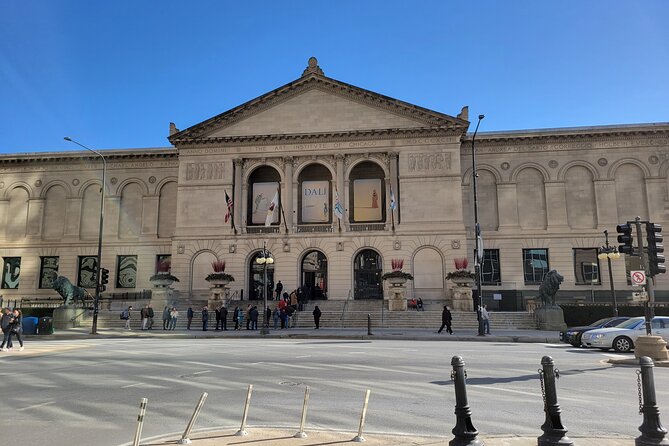
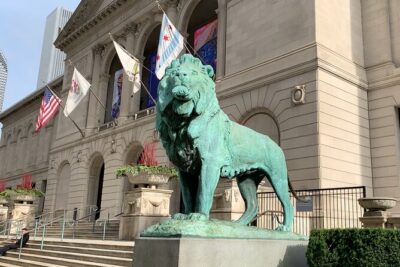
You meet at the Art Institute of Chicago, at 111 South Michigan Avenue. The tour begins at 10:30 am and ends back at the meeting point, so the plan is easy to fit into a day in central Chicago.
Admission fees are included. The skip-the-line format is especially useful if you have limited time in the city or do not want to spend part of your morning dealing with entry arrangements. It also means you can focus on the collection as soon as the tour begins.
Arrive ready to walk. The museum is large, and a two-and-a-half-hour route requires steady movement between rooms. You should also expect to stand for long stretches while the guide explains a painting or compares several works.
The museum is near public transportation, which makes the starting point convenient. Confirmation is provided when you book, and the activity accepts service animals. Free cancellation is available until 24 hours before the start time. Changes or cancellations inside that window are not accepted for a refund.
The first gallery: Tiffany glass and grand Chicago style
One possible early stop is the Hartwell Memorial Window by Tiffany Studios. It is a good introduction to the museum because it shows that the collection is not only about paintings. Light, color, craft, and the design of the building all matter here.
Tiffany’s glasswork rewards a close look. From a distance, it reads as a glowing landscape. Up close, you begin to notice the pieces of glass, the shifting colors, and the careful construction. A guide can help you look at the work as both an image and a physical object.
This kind of opening also sets up a Chicago theme. The city is strongly associated with architecture, design, collecting, and civic institutions. The Art Institute feels connected to that wider story, not like an isolated box of old pictures.
Paris streets and the shock of modern city life
Gustave Caillebotte’s Paris Street; Rainy Day is one of the museum’s most instantly readable paintings. You see broad streets, wet pavement, umbrellas, and people moving through a newly redesigned Paris. The painting feels like a city scene, but its unusual scale and cropped composition make it more than a simple snapshot.
A guide can point out how Caillebotte places you inside the street rather than safely outside it. The figures seem to pass close by, and the broad open space gives the scene a slightly detached mood. It is a useful work for showing how modern urban life changed what artists chose to paint.
This is also where the tour’s Chicago references can add value. Guides such as Joel are praised for linking art to the city around you. That connection helps you see the Art Institute as part of Chicago’s story, rather than just a stop on a museum checklist.
A few more Chicago tours worth a look before you decide
- Chicago: Art Institute Skip-the-Line Tour with Guide
★ 5.0 · 49 reviews
Seurat’s dots and the pleasure of looking slowly
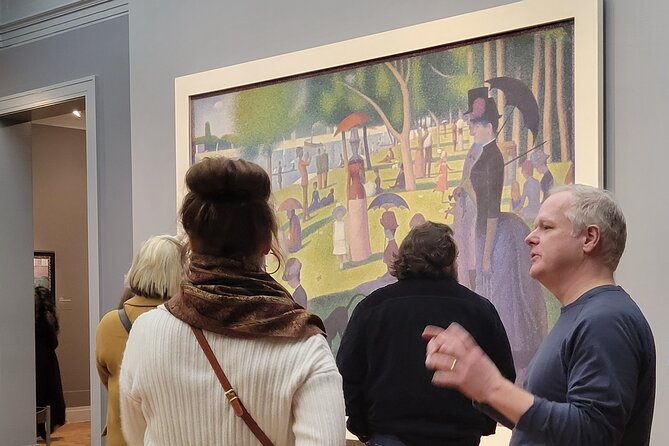
Georges Seurat’s A Sunday on La Grande Jatte is a major highlight and one of the paintings that benefits from expert explanation. From across the room, the scene looks calm and orderly. Move closer and the surface breaks into small touches of color.
Seurat used a method based on color theory and visual mixing. Your eye does some of the work, blending the marks as you step back. The guide can show you how the painting changes with distance and explain why Seurat’s technique mattered to later artists.
This is one of the tour’s useful teaching moments. You do not need a degree in art to understand the basic idea, but it helps to have someone direct your attention to the brushwork. Without that nudge, you might admire the scene and walk on without noticing how radical its construction was.
Van Gogh’s bedroom and the power of a familiar image
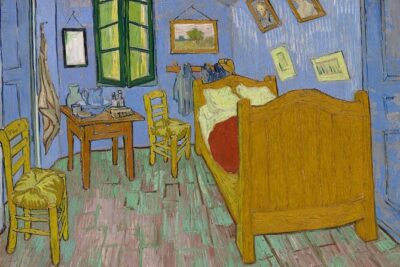
Vincent van Gogh’s The Bedroom is among the most recognizable works in the museum. Its simple subject, a small room with a bed and basic furnishings, becomes striking through strong color, compressed space, and energetic lines.
The guide will likely discuss Van Gogh’s life and his reasons for painting the room. The value here is not just learning biographical facts. You begin to see how the tilted perspective and intense colors create a feeling of emotion inside an ordinary space.
This is a good stop for first-time art museum visitors because the painting is approachable. You can talk about what the room feels like before worrying about technical terms. The strongest guides, including Joel and Marlin, are praised for using stories to make that kind of connection.
American art, from Hopper to Wood
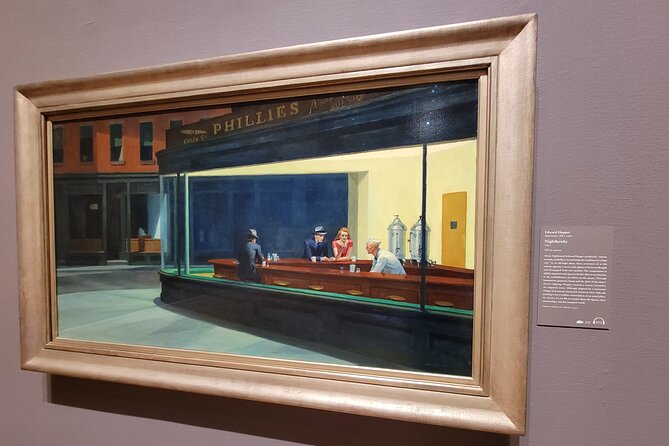
Edward Hopper’s Nighthawks is another major draw. Its late-night diner, isolated figures, and glowing interior are easy to recognize, but the painting leaves plenty of room for questions. Why are the people together yet so separate? Why does the street outside feel empty? What makes the scene tense even though almost nothing is happening?
A good guide does not need to settle every question. Instead, you get useful clues about Hopper’s choices and the mood of American city life. The painting rewards a few quiet minutes, although the tour’s schedule may not allow as much time as you would choose on your own.
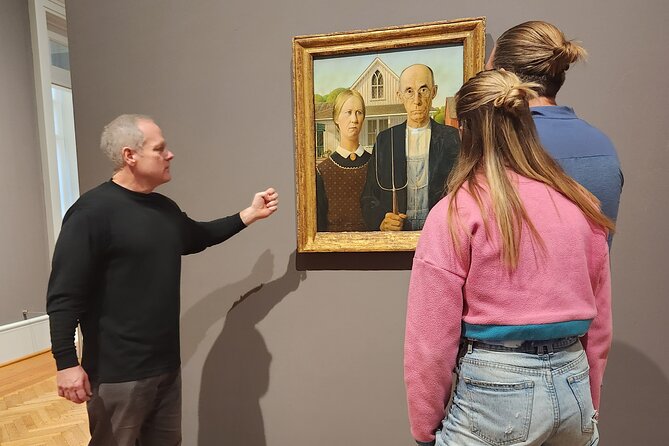
Grant Wood’s American Gothic shifts the mood. The stiff pose, pitchfork, and plain clothing have made the work a familiar symbol of rural America, but it is easy to forget how carefully staged the image is. The guide can add context about the figures, the setting, and the way the painting has been reused in popular culture.
Ivan Albright’s A Picture of Dorian Gray offers a very different kind of American art. It is unsettling, elaborate, and hard to dismiss. Including a work like this keeps the route from becoming a parade of only the prettiest or most famous paintings.
O’Keeffe, Chagall, and Pollock show the collection’s range
Georgia O’Keeffe’s Sky Above Clouds gives you a change of scale and mood. The repeated cloud forms can look simple at first, but the work invites you to think about pattern, distance, and the feeling of looking down from above.
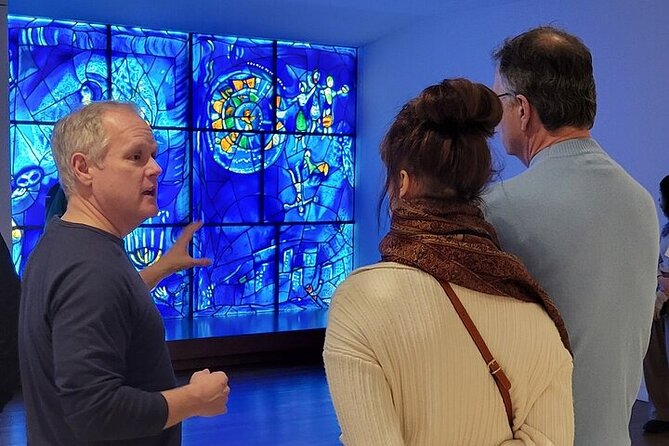
Marc Chagall’s America Windows brings color and glass back into the tour. It is a bright, symbolic work with a strong decorative presence. Seen after Tiffany’s window, it also lets you compare two approaches to stained glass from different periods.
Jackson Pollock’s Greyed Rainbow is a useful stop for anyone who wonders what abstract painting is trying to do. The title offers one clue, but the surface itself carries much of the experience. A guide can help you consider movement, layering, rhythm, and the physical act of painting without reducing the work to a single answer.
These stops show why a guided route is helpful. The museum is not organized around one neat story. A guide can make connections between artists who worked in different places and periods, helping you see the collection as a series of conversations.
Picasso and Warhol complete the modern art run
Pablo Picasso’s The Old Guitarist is one of the Art Institute’s best-known works. Its blue tones and narrow, bent figure create a strong emotional effect. The guide can place it within Picasso’s early Blue Period and explain how the subject and color work together.
Andy Warhol’s Four Mona Lisas gives you a jolt after Picasso. Warhol takes one of Western art’s most famous images and repeats it, shifting your attention from the sitter’s identity to reproduction, celebrity, and mass culture.
That pairing is smart in a highlights tour. You move from a painting that feels personal and sorrowful to a work that asks what happens when an image becomes a product. The contrast makes both works easier to remember.
What the guides add to the experience
The individual guide matters a great deal on this tour. The strongest feedback centers on people who combine art knowledge with a natural speaking style.
Joel receives repeated praise for his enthusiasm, humor, and stories about both artists and Chicago. Bernie is valued for organizing the route efficiently and helping people understand where to go next. Scout is described as charming, funny, and good at mixing art facts with Chicago history.
Colleen is praised for navigating the museum smoothly and showing the highlights before the galleries become harder to manage. Arnold is noted for answering questions and adapting to the group. Robert is described as an eloquent storyteller, while Michelle is appreciated for adding period context and personal details about artists.
You cannot choose one of these guides from the information provided, so keep your expectations focused on the format rather than a particular person. The consistent strength is the guide-led approach: stories, clear explanations, and help finding the important rooms.
The main drawback: speed over quiet looking
The tour covers a lot. That is its purpose, but it also creates the main limitation.
You may stop at many important works without having enough time to study each one. One especially useful way to think about the experience is as a first visit and orientation. Let the guide show you the museum’s major rooms, then return to your favorite paintings afterward if you have time.
The tour is not ideal if your priority is spending 20 minutes with a single artist or sketching in one gallery. It is also less suitable if you dislike group pacing. The maximum of 12 people is small, but it is still a group, and the guide has to keep everyone moving.
A single three-star experience reflects this concern: the visitor felt the route focused too much on the museum itself and skipped some important pieces. That criticism is worth taking seriously. No two-and-a-half-hour tour can cover an institution this large, and the exact balance between museum orientation and individual artworks may vary by guide and day.
Is $71.40 a fair price?
At $71.40 per person, this is not the cheapest way to enter the Art Institute. You are paying for admission, skip-the-line access, and a semi-private English-language tour rather than admission alone.
The value depends on your visit. If you have only a few hours in Chicago, the price can make sense because you get a planned route through major works without spending your limited time studying a map or searching gallery numbers. You also have a guide available for questions, which is useful if art museums sometimes leave you unsure where to begin.
If you already know the museum well, or if you prefer to wander at your own speed, buying admission and exploring alone may suit you better. The tour is strongest for first visits, short stays, families, couples, and anyone who wants an art history overview without doing advance research.
The inclusion of admission also matters because you can continue enjoying the museum after the guided portion if your schedule allows. Use the tour to get your bearings, then return to the works that caught your attention.
Who should book this Art Institute tour?
I would choose this tour if you want the museum’s major names in one organized visit. It is especially useful for first-time visitors, people with limited time, and families who need a route that keeps the day moving.
It also suits curious beginners. You do not need an art background, and the guides are praised for explaining difficult ideas through stories and plain language. If you already know a fair amount about art, you may still enjoy the personal details, Chicago connections, and questions that arise along the way.
I would skip it if you want a silent, unhurried museum morning. The pace is brisk, and the itinerary is built around coverage. You should also reconsider if standing and walking for 2 hours and 30 minutes would be difficult, since a moderate level of physical fitness is requested.
Should you book it?
Book it if you want a well-planned introduction to the Art Institute and value a guide who can make famous works easier to read. The combination of a small group, included admission, and a 10:30 am start gives you a practical way to make good use of a short Chicago visit.
Do not book it expecting to see every important artist or spend long periods in each gallery. Think of this as an energetic first pass through one of America’s great museums. For most first-time visitors, that is a sensible trade.
FAQ
How long does the Art Institute of Chicago tour last?
The tour lasts approximately 2 hours and 30 minutes.
What time does the tour begin?
The scheduled start time is 10:30 am.
Where does the tour meet?
The meeting point is the Art Institute of Chicago at 111 S Michigan Ave, Chicago, Illinois 60603.
Where does the tour end?
The activity ends back at the meeting point.
Is museum admission included?
Yes. All admission fees are included.
What is the maximum group size?
The group has a maximum of 12 people.
Is the tour offered in English?
Yes. The experience is offered in English.
Which artists may you see during the tour?
The route may include works by Vincent van Gogh, Georgia O’Keeffe, Jackson Pollock, Gustave Caillebotte, Georges Seurat, Edward Hopper, Grant Wood, Marc Chagall, Pablo Picasso, Andy Warhol, Ivan Albright, and Tiffany Studios.
Is the tour suitable for people with limited mobility?
The experience asks participants to have a moderate level of physical fitness. Specific mobility accommodations are not provided in the tour information, so you should confirm details before booking if needed.
Can you cancel for a full refund?
Yes. You can cancel at least 24 hours before the experience start time for a full refund. Cancellations or changes made less than 24 hours in advance are not accepted for a refund.
Just added in Chicago
- Chicago: Architecture and Engineering Marvels Walking Tour★ 5.0 · 3 reviews
- Private Downtown Chicago TV and Movie Sites Guided Walking Tour★ 4.5 · 3 reviews
- Black Heritage Tour★ 5.0 · 3 reviews
- Private SUV Transfer from Chicago Downtown to Midway airport★ 5.0 · 3 reviews
- Private Holiday City Tour★ 5.0 · 3 reviews
- Chicago 4-Hour Sightseeing Transfer by Luxury SUV★ 4.5 · 3 reviews
- BYOB Chicago River Guided History Tour★ 5.0 · 4 reviews
- Chicago, Cloud Gate, Grant Park Full-Day City Tour★ 4.0 · 4 reviews
Art Institute of Chicago Tours, compared.
Private Art Institute of Chicago Skip-the-Line Guided Tour
Read our review →
Skip the Line Art Institute of Chicago Tour Semi-Private 8ppl Max
Read our review →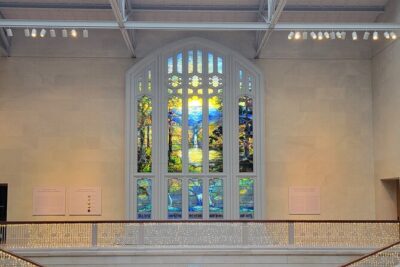
Art Institute of Chicago Private Expert Guided Tour
Read our review →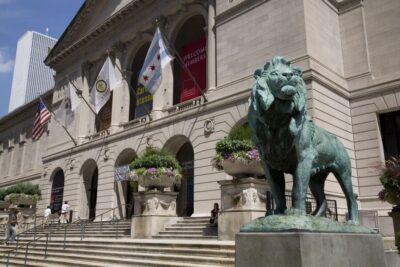
Ferris Bueller Movie Tour at the Art Institute of Chicago
Read our review →Browse the lists this tour appears in