
Reviewed · CHICAGO ARCHITECTURE TOURS
Chicago’s Secret Interiors Architectural Walking Tour
Chicago hides some of its best architecture behind ordinary-looking doors. This two-hour walking tour takes you from Union Station through the Loop, where grand lobbies, mosaic floors, frescoed ceilings, and old department-store details are easy to miss without someone pointing them out. You get the city’s famous towers, too, but the real treat is looking inward.
I like the mix of major landmarks and overlooked interiors, especially the Rookery, Marquette Building, Palmer House, and Marshall Field and Company Building. I also like the human stories: magnates, hotel guests, architects, engineers, and the commercial forces that helped shape Chicago. One consideration is the weather. You walk between buildings, and the route may last closer to an hour and a half on some departures, though much of the time is indoors.
In This Review
- The tour’s best features at a glance
- Why Chicago’s interiors matter as much as its skyline
- Union Station begins the story with grand scale
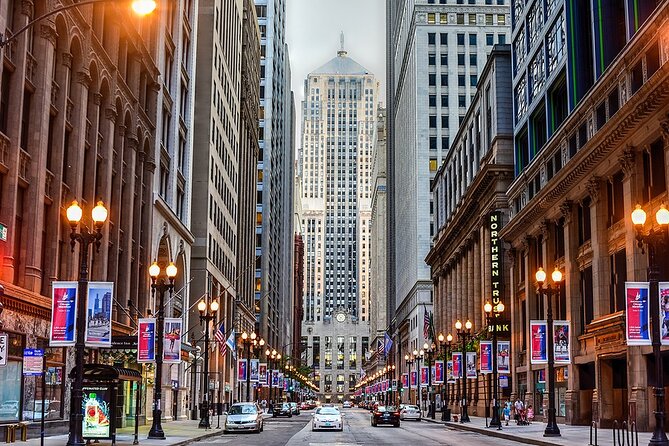
- LaSalle Street reveals the Financial Canyon
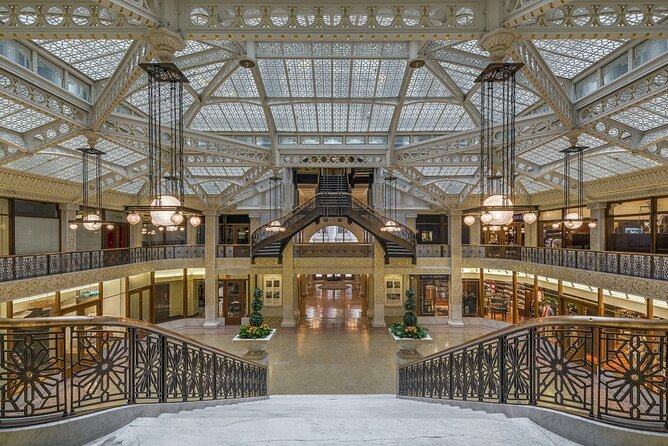
- The Rookery combines early Chicago and Frank Lloyd Wright
- The Field Building brings Art Deco into the route
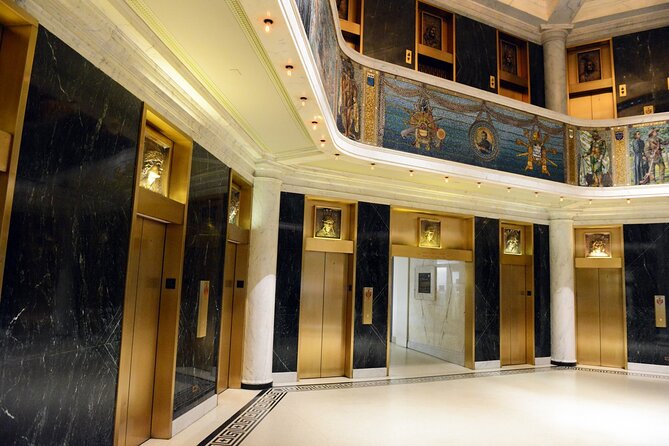
- The Marquette Building turns a lobby into a history lesson
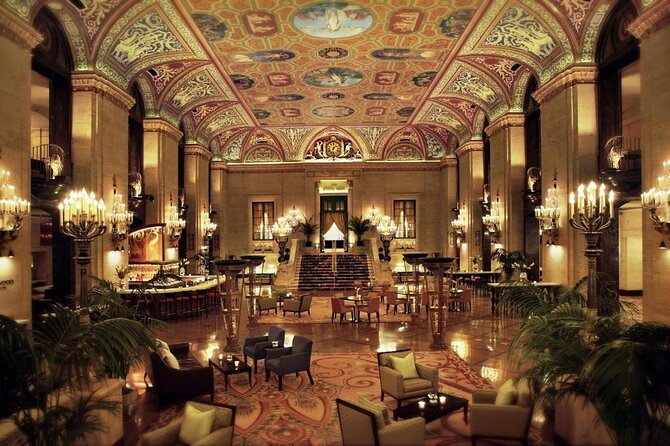
- Palmer House preserves Gilded Age theater
- The Cultural Center or Monadnock adds a variable stop
- Macy’s and the Tiffany dome provide a fitting finish
- How the pace, guides, and group size affect the experience
- Weather, footwear, and practical planning
- Is $35 a fair price?
- Who should book this Loop walking tour?
- FAQ
- How long is Chicago’s Secret Interiors Architectural Walking Tour?
- Where does the tour begin and end?
- Is the Rookery Building included every day?
- Will the tour visit the Chicago Cultural Center?
- What is included in the $35 price?
- What is the cancellation policy?
- Should you book it?
The tour’s best features at a glance
- The Rookery’s Frank Lloyd Wright lobby: See the light court, ironwork, and elegant interior redesign, except on Sundays when the building is closed.
- Chicago’s Financial Canyon: Look up at the Board of Trade, Willis Tower, and other tall buildings while learning how commerce shaped the Loop.
- Palmer House interiors: Enter one of Chicago’s grand old hotels to see its frescoed ceiling, mosaic floors, and bronze peacock doors.
- Marquette Building mosaics: Study a lobby that uses art to tell the story of Jacques Marquette and early Illinois exploration.
- Macy’s Tiffany glass dome: Finish at the former Marshall Field and Company Building, where retail history meets fine architectural craft.
- Small-group format, with a caveat: The advertised maximum is 15 people, though one account describes a much larger group, so confirm group size if that matters to you.
Why Chicago’s interiors matter as much as its skyline
Chicago is often treated as an outdoor architecture museum. You look up from LaSalle Street, count the floors of Willis Tower, and admire the ornate facades of the Loop. That is worthwhile, but the street view tells only half the story.
The interiors explain how these buildings worked as places of business, transport, shopping, and social display. A lobby could announce a company’s power before you reached the elevator. A hotel ceiling could impress a wealthy visitor. A department-store dome could turn a shopping trip into a public spectacle.
That is the central strength of this tour. You are not only told who designed a building. You are shown how materials, structure, money, and ambition came together. The guide also explains the engineering problems behind Chicago’s height and density, which gives the skyline more meaning once you see it from the street.
The tour begins at Chicago Union Station, at 225 South Canal Street, and ends near Macy’s at 111 North State Street. That route moves through the central Loop rather than scattering you across the city. It is a useful half-day plan, especially if you want an introduction before exploring museums, shops, or the Riverwalk on your own.
More architecture tours in Chicago:
- Chicago Architecture River Cruise
★ 5.0 · 15,756 reviews - Chicago River 90-Minute Architecture Tour
★ 4.5 · 9,629 reviews - Chicago River: 1.5-Hour Guided Architecture Cruise
★ 4.8 · 8,046 reviews
Union Station begins the story with grand scale
Union Station is the starting point, not just a place to gather. Designed by Daniel Burnham and completed in 1925, it introduces the formal Beaux-Arts style that appears in several parts of the route.
The Great Hall is the main attraction. Its skylight, broad proportions, and decorative finish make it feel more like a civic palace than a place built simply to move people from train to train. The station also gives you a good opening lesson in Chicago’s role as a major transport and commercial center.
Your time at each listed stop is about 10 minutes, but walking and explanation fill out the schedule. Do not expect a long, leisurely study of every room. The value comes from seeing several places in one continuous route and learning what to notice in each.
LaSalle Street reveals the Financial Canyon
From Union Station, the route moves toward LaSalle Street and the financial district. Here, the city’s tall buildings create the canyon effect that makes Chicago feel so vertical at street level.
The Chicago Board of Trade is the visual star. Its Art Deco design gives the lower end of LaSalle Street a strong sense of ceremony, while Willis Tower represents a later push toward height. The guide connects these buildings to finance, trade, architecture, and the practical pressures of a growing city.
This part of the tour works best if you pause to look both up and down. The upper floors tell you about competition and modern engineering. The lower sections reveal carved stone, metalwork, entry details, and the narrow view created by the surrounding towers.
You will hear about the architects and business interests behind the buildings. That context helps explain why the Loop contains such different styles within a short walk. Chicago was not built in one grand campaign. It grew through changing technologies, industries, and ideas about what a business district should look like.
The Rookery combines early Chicago and Frank Lloyd Wright
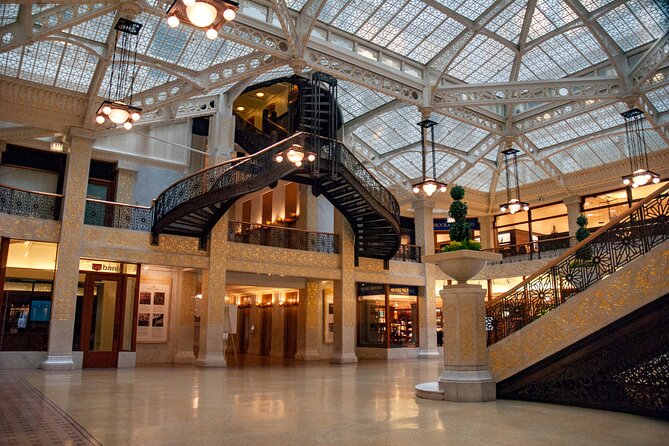
The Rookery is likely to be one of the strongest stops. Burnham and Root designed the building in 1888, and its interior later received a redesign by Frank Lloyd Wright. That combination gives you two important chapters in Chicago architecture under one roof.
Look for the light court, intricate ironwork, Romanesque and Moorish touches, and the oriel staircase. The building shows how architects used decoration while also working with new structural ideas. It is not a plain office block dressed up after the fact. Its circulation areas were designed to make arrival and movement part of the experience.
The Rookery is closed on Sundays, so it is left off the route that day. This is the most important scheduling detail in the whole tour. If the building is high on your wish list, do not book a Sunday departure.
The stop is brief, which means you will need to listen while looking. If you enjoy architectural photography, the interior may tempt you to linger longer than the group can. The guide-led visit gives you access and context, but independent exploration would offer more time for close study.
More walking tours in Chicago:
- Chicago: Gangsters and Ghosts Walking Tour
★ 5.0 · 7,155 reviews - Chicago Favorites Ultimate Food and Walking Tour
★ 5.0 · 1,962 reviews - Chicago: Gangsters and Ghosts Guided Walking Tour
★ 4.7 · 1,697 reviews - Chicago in a Day: Food, History & Architecture Walking Tour
★ 5.0 · 1,153 reviews
The Field Building brings Art Deco into the route
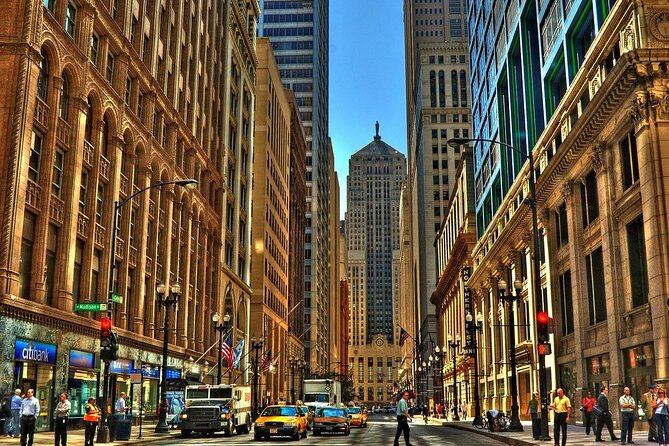
The historic Field Building shifts the mood from early skyscraper design to Art Deco. Its design reflects the period when Chicago buildings used strong geometry, polished surfaces, and carefully controlled ornament to express modern business confidence.
The point here is not only the style label. The guide helps you see how the building fits into the city’s broader architectural sequence. After the Romanesque and Moorish elements of the Rookery, the Field Building shows a more streamlined idea of corporate grandeur.
You may appreciate this stop most if you enjoy comparing details. Notice how the materials and decorative language differ from the older buildings. The tour gives you a quick way to make those comparisons without studying architecture books before you arrive.
The Marquette Building turns a lobby into a history lesson
The Marquette Building is another interior highlight. It is known for its use of the Chicago window and its terra cotta facade, both important parts of the Chicago School approach to tall-building design.
Inside, the lobby mosaics tell the story of Jacques Marquette’s exploration of Illinois. This is where architecture and local history meet most clearly. The artwork is not merely decoration. It gives the building a narrative tied to the region.
The Marquette is also useful for understanding how early skyscrapers brought daylight into deep office spaces. The Chicago window helped make large commercial buildings more workable, while the ornate lobby gave employees and clients a sense of importance.
The stop lasts about 10 minutes, so the guide has to keep the group moving. Still, it is long enough to see why this building is more than another handsome facade. If you remember only one thing here, remember to look at the windows outside and the mosaics inside.
Palmer House preserves Gilded Age theater
The Palmer House offers a different kind of architecture. This is a hotel built to impress, and its public spaces still carry the mood of the Gilded Age.
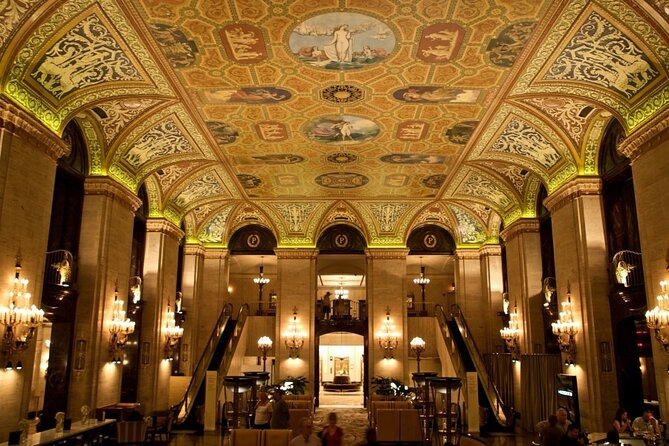
The hotel was rebuilt after the Great Chicago Fire of 1871. Its lobby features a frescoed ceiling, mosaic floors, and large bronze peacock doors. These details were meant to signal luxury to arriving guests, and they still make the hotel feel like a place of ceremony rather than a plain commercial building.
The guide also brings in stories about celebrities, dignitaries, magnates, and stars connected with Chicago’s Gilded Age and Roaring Twenties. That social history helps you understand why hotels mattered so much. They were not just sleeping places. They were meeting points for business, politics, entertainment, and status.
This stop is a good reminder that Chicago architecture is not all about height. A hotel lobby can reveal just as much about a city’s ambition as a skyscraper viewed from the sidewalk.
The Cultural Center or Monadnock adds a variable stop
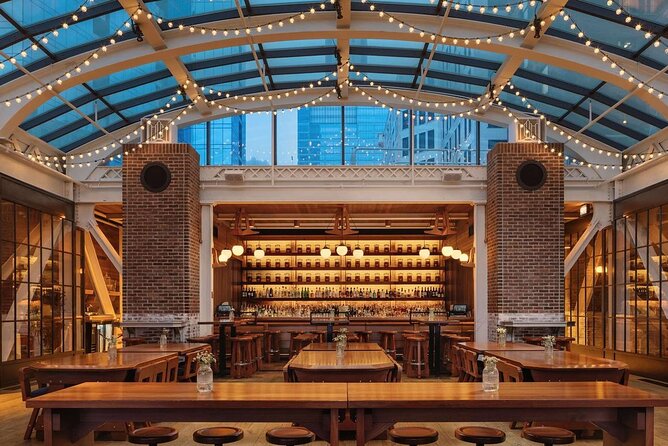
At the eighth stop, the route includes either the Chicago Cultural Center or the Monadnock Building. The exact choice matters because the two offer different kinds of interest.
The Chicago Cultural Center provides another dose of civic grandeur and interior decoration. It is a natural fit for anyone who likes domes, ornamental detail, and buildings designed to represent public culture.
The Monadnock Building offers a lesson in late 19th-century commercial design. It is tied to the period when Chicago architects were working out how to build tall office blocks while preserving a strong, solid street presence.
Because you may see one or the other, do not book this tour expecting both. The uncertainty is a small drawback, but the broader route still gives you plenty of variety. I would ask the operator which building is planned for your departure if one is especially important to you.
Macy’s and the Tiffany dome provide a fitting finish
The tour ends at the Marshall Field and Company Building, now home to Macy’s, at 111 North State Street. This is a strong finish because it brings the story back to retail, display, and public life.
The famous Tiffany glass mosaic dome is the main interior feature. It is a fine example of how a department store used craftsmanship to make shopping feel grand. The walnut-paneled Tea Room adds another layer, showing how a store could include spaces for leisure and social activity as well as sales.
The building connects architecture to Chicago’s economic past. Retail was not an afterthought in the city’s growth. Department stores helped shape the Loop, attract crowds, and turn downtown into a place where commerce and spectacle worked together.
Since this is the endpoint, you can continue exploring the store and nearby State Street after the guide leaves. The route does not return to Union Station, so plan your next stop from downtown rather than assuming you will end where you began.
How the pace, guides, and group size affect the experience
The tour is advertised at about two hours, with roughly 10 minutes assigned to each major stop. Walking between buildings, street crossings, introductions, and a possible 15-minute break account for the rest of the time.
Some people have found the actual route closer to an hour and a half. That may suit you if you want a compact introduction rather than a long lecture. It may disappoint you if you hope to spend extended time inside each building.
The guides are a major part of the experience. Ethan is described as animated, passionate, clear, and especially strong at connecting architecture with broader Chicago history. Grant is noted for warmth, organization, and keeping a group together at a steady pace. Ty brings humor and a sharp point of view, while Matthew is praised for balancing professionalism with wit.
Those qualities matter on a walking tour. The buildings are impressive, but a flat delivery would make the short interior visits feel rushed. The strongest guides keep you moving while giving you a reason to look at one more cornice, window, mosaic, or ceiling.
The stated maximum is 15 people. One account describes a group of about 40, so the actual size may vary by departure or operating conditions. If hearing every explanation is important to you, confirm the expected group size before booking.
Weather, footwear, and practical planning
You will spend part of the tour outdoors, so Chicago weather deserves attention. A cold or rainy day does not necessarily ruin the outing because many stops are indoors, but you still need a coat, rain protection, and comfortable shoes.
The route is in the Loop and near public transportation. Start at Union Station and finish at Macy’s, so allow time to reach the first meeting point and plan your onward route from State Street.
A mobile ticket is provided, and confirmation arrives at booking. Service animals are allowed, and the activity is described as suitable for most people. The tour requires good weather, and a weather cancellation brings the choice of another date or a full refund.
Free cancellation is available until 24 hours before the start time. Inside that window, refunds are not provided, and changes are not accepted. Keep that cutoff in mind if the forecast looks uncertain.
Is $35 a fair price?
At $35, the tour is priced well for a guided introduction to several major Chicago interiors. You are paying for access, route planning, and interpretation rather than admission to a single major attraction.
The value is strongest if you would otherwise walk past these buildings without entering or knowing what to look for. The Rookery, Marquette Building, Palmer House, and Macy’s dome can be appreciated independently, but the guide supplies the links between them.
The price is less compelling if you already know the Loop well and prefer to move at your own pace. You also need to accept the short stop times and the possibility that the Cultural Center or Monadnock Building will be substituted for the other.
The high rating and 98 percent recommendation fit the tour’s main strengths: guides who explain well, a route packed with visual variety, and a useful balance of outdoor city views and indoor shelter. The one serious problem in the supplied feedback is a no-show guide, followed by a delayed refund offer. That appears to be an isolated service failure, but it is still worth noting because a missed tour wastes a fixed part of your day.
Who should book this Loop walking tour?
I would choose this for a first or second Chicago visit, especially if you like architecture, local history, design, engineering, or old hotels and department stores. It also works well for a Chicago resident who has seen the skyline but rarely entered the historic buildings.
The tour suits you if you enjoy learning while walking and do not need long stretches of free time at each stop. It is also a good companion to a Chicago architecture boat tour because the focus is different: the boat shows the city from the river, while this route takes you through doors and lobbies.
It may not suit you if you have limited mobility, dislike changing pace on city sidewalks, or want a quiet, self-guided visit. The tour is described as suitable for most people, but the provided details do not specify step-free access at every building.
FAQ
How long is Chicago’s Secret Interiors Architectural Walking Tour?
The tour lasts approximately two hours. Individual stops are listed at about 10 minutes, with walking time between buildings and, on some departures, a break. Some accounts describe the route lasting around an hour and a half.
Where does the tour begin and end?
The tour begins at Chicago Union Station, 225 S Canal St, Chicago. It ends at the Marshall Field and Company Building, now Macy’s, at 111 N State St.
Is the Rookery Building included every day?
No. The Rookery is closed on Sundays, so it is not included on the Sunday route.
Will the tour visit the Chicago Cultural Center?
The route includes either the Chicago Cultural Center or the Monadnock Building. The provided details do not guarantee which one will be visited on a particular departure.
What is included in the $35 price?
An expert tour guide is included. The tour information does not list separate admission charges for the stops.
What is the cancellation policy?
You can cancel at least 24 hours before the start time for a full refund. Cancellations or changes made less than 24 hours before the start time are not accepted for a refund. If poor weather cancels the tour, you are offered another date or a full refund.
Should you book it?
Book this tour if you want Chicago’s architecture explained at street level and inside the buildings, not just viewed from a distance. The Rookery, Palmer House, Marquette Building, and Tiffany dome make the $35 worthwhile, while guides such as Ethan, Grant, Ty, and Matthew add the stories that turn decorative details into part of Chicago’s larger story.
Choose a weekday if the Rookery is a priority, wear shoes suited to city walking, and confirm the expected group size if you prefer a quieter experience. For architecture fans, first-time visitors, and locals ready to see familiar streets differently, this is a smart, compact way to meet the Loop from the inside.
Just added in Chicago
- Chicago: Architecture and Engineering Marvels Walking Tour★ 5.0 · 3 reviews
- Private Downtown Chicago TV and Movie Sites Guided Walking Tour★ 4.5 · 3 reviews
- Black Heritage Tour★ 5.0 · 3 reviews
- Private SUV Transfer from Chicago Downtown to Midway airport★ 5.0 · 3 reviews
- Private Holiday City Tour★ 5.0 · 3 reviews
- BYOB Chicago River Guided History Tour★ 5.0 · 4 reviews
- Chicago 4-Hour Sightseeing Transfer by Luxury SUV★ 4.5 · 3 reviews
- Chicago, Cloud Gate, Grant Park Full-Day City Tour★ 4.0 · 4 reviews
Chicago Architecture Tours, compared.
Chicago Architecture Center River Cruise aboard First Lady
Read our review →
Architecture River Cruise Skip-the-Ticket Line
Read our review →
Chicago River 45-Minute Architecture Tour from Magnificent Mile
Read our review →
45-Minute Family-Friendly Architecture River Cruise
Read our review →Browse the lists this tour appears in