
Reviewed · CHICAGO ESCAPE ROOMS & SCAVENGER HUNTS
Eastside Chicago The Heist Exploration Game and Tour
Chicago’s best feature in this self-guided city game is its route through major public sights. You move from the Art Institute of Chicago to Cloud Gate, Crown Fountain, Buckingham Fountain, and several lesser-known works, answering clues as you go. It turns a familiar downtown walk into a small puzzle hunt.
I like the low price, about $7.20 per person, and the freedom to start at any hour. I also like that you can play with family or friends, pause for food or photos, and continue later without joining a larger group. The catch is that the app’s directions and location range may not always be forgiving, especially near construction or fountains.
In This Review
- Key points at a glance
- What this Chicago heist game is really like
- Starting at the Art Institute of Chicago
- Public art around Millennium Park
- Wrigley Square and the story beneath Lurie Garden
- The Chicago Stock Exchange Arch and Grant Park
- Lincoln, Solti Garden, and Taft’s Fountain
- Finishing near the School of the Art Institute
- How the phone-based challenges affect the walk
- Is $7.20 good value?
- Who should book this experience?
- Should you book the Chicago Heist Exploration Game?
- FAQ
- How long does the Eastside Chicago Heist Exploration Game take?
- Where does the activity start?
- Where does the activity end?
- Is a physical tour guide included?
- Can I play without an internet connection?
- Can I pause the game and continue later?
- What language is the game offered in?
- Can I cancel for a full refund?
Key points at a glance
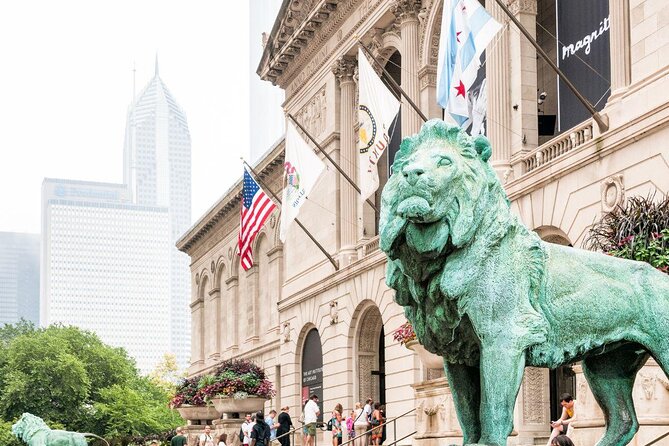
- A 95-minute route through Chicago’s art center: Visit the Art Institute, Millennium Park, Grant Park, and nearby monuments.
- A game rather than a guided tour: Your phone gives you challenges and facts, but no person leads the walk.
- Offline play is included: You can use the game without an internet connection after preparing it on your phone.
- Cloud Gate and Crown Fountain are central highlights: The route mixes famous photo stops with public art that many people walk past.
- Flexible timing suits independent schedules: Start anytime, stop whenever you like, and resume later.
- Construction and GPS range can matter: Some challenges may require hints or an expanded radius if access is blocked.
What this Chicago heist game is really like
Think of this as a walking tour with a puzzle layer added. You are not following a guide who explains each site in a set speech. Instead, your phone sends you to the next location, asks you to inspect something nearby, and uses your answer to move the story along.
That format works best if you enjoy looking closely. A carved detail, a date, a color, or the shape of a monument may provide the answer. The educational material gives each stop a bit of context, so you get more than a list of photo locations.
The route takes about one hour and 35 minutes, though your actual time can run longer. You may stop for pictures at Cloud Gate, pause at the Art Institute, or take a break in the park. Since this is a private activity, only your group takes part.
The game is available in English. It is open all day, every day, with booking hours listed from midnight to 11:59 p.m. That makes it easy to fit around a museum visit, a meal, or an evening event.
More escape rooms and outdoor games:
- The Escape Game Chicago: Epic 60-Minute Adventures in River North
★ 5.0 · 332 reviews - Outdoor Escape Room in Chicago – Fulton Market
★ 5.0 · 28 reviews - Chicago: 1-Hour Escape Room Adventure
★ 5.0 · 27 reviews
Starting at the Art Institute of Chicago
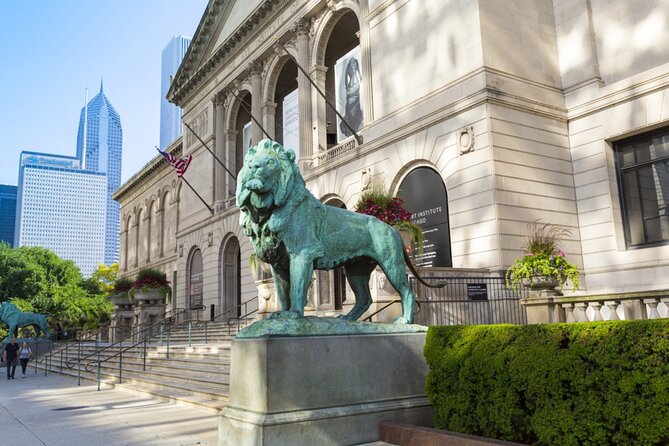
The starting point is 111 South Michigan Avenue, outside the Art Institute of Chicago. This is a useful beginning because the museum is not just a famous building with a grand entrance. It grew from Chicago’s effort to rebuild after the Great Fire of 1871.
Founded in 1879 as both a museum and an art school, the Art Institute reflects the city’s push to become a major cultural center. The game asks you to look around and find the information needed for the first challenge.
You do not need to enter the museum to take part in the outdoor route, and admission to the Art Institute is not included. That distinction matters. If you want to visit the galleries, plan that as a separate activity and allow extra time.
The opening challenge sets the tone. You need to pay attention to your surroundings instead of simply walking from one pin to another. If you prefer a traditional explanation from a human guide, this will feel spare. If you like solving small questions as you go, it gives the first stretch of the walk a clear purpose.
Public art around Millennium Park
The next section brings you into Millennium Park, where the game focuses on works that are easy to spot but rewarding to examine.
One stop features Alexander Calder’s Flying Dragon. Calder worked for about five decades and used a red-orange color on this stainless steel sculpture, the same bold color associated with his Flamingo in Chicago’s Federal Center Plaza.
This is a good example of how the activity adds detail to a quick sightseeing stop. You may have seen the sculpture without knowing its artist or noticing the connection to another Chicago work. The challenge asks you to inspect the piece for an answer, so the art becomes part of the game rather than background decoration.
Crown Fountain offers a very different mood. Designed by Spanish artist Jaume Plensa and completed with Krueck and Sexton Architects, it opened in July 2004. It is an interactive public artwork and video sculpture, located in Millennium Park’s Loop area.
The game uses the fountain as another observation point. Take care here: the challenge depends on being in the right area, and the location system may be sensitive to your position. You should not assume that moving into a restricted or wet section is necessary. If the app cannot detect your group, an expanded radius or hint may be needed.
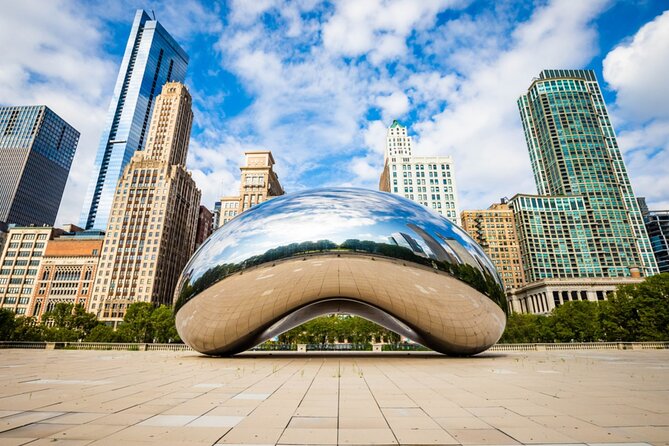
Then comes Cloud Gate, the polished stainless steel sculpture widely known for reflecting the skyline and sky. It weighs 110 tons and was made from seamless stainless steel plates. It was British artist Anish Kapoor’s first public outdoor work in the United States.
This is likely the biggest photo stop on the route. The game gives you a reason to look at the sculpture from more than one angle. Still, remember that Cloud Gate can be crowded, and getting a clear view may take patience. The activity avoids a fixed group schedule, but it cannot remove the people around the artwork.
Wrigley Square and the story beneath Lurie Garden
At Wrigley Square, you find the Millennium Monument, a near full-size copy of a semicircle of paired Roman Doric columns. The original peristyle occupied this part of Grant Park from 1917 to 1953, near Michigan Avenue and Randolph Street.
The square also has a lawn and public fountain. This is one of the calmer parts of the route, giving you room to stop, check the next instruction, and take a short rest. It also shows how Chicago often places formal classical designs beside newer public art.
Lurie Garden adds a different layer. The site was once low and watery, so it was filled and raised, much of it with rubble from the Great Fire. It now sits on the roof of a parking garage, beneath the garden that tells the story of what lies below the modern park.
That fact gives the walk a useful sense of time. You are not simply crossing landscaped parkland. The ground itself was reshaped after disaster, and the garden occupies an elevated structure with an older city buried beneath it.
The app’s format is helpful here because you can pause without holding up a group. If the route’s questions feel too obvious or playful for your taste, this section may seem less like a formal history lesson and more like a casual scavenger hunt.
A few more Chicago tours worth a look before you decide
- Medieval Torture Museum Ticket with Audio Guide and Ghost Hunting
★ 5.0 · 962 reviews - Chicago Self-Guided Audio Tour
★ 4.0 · 9 reviews - Chicago’s Gold Coast Hidden History: A Self-Guided Audio Walk
★ 4.5 · 7 reviews - Chicago Riverwalk Self-Guided Walking Tour
★ 4.0 · 6 reviews
The Chicago Stock Exchange Arch and Grant Park

The Chicago Stock Exchange Arch is a surviving fragment from the Chicago Stock Exchange building designed in 1893. It is installed outside the Art Institute, making it a compact stop with a strong architectural connection to the city’s past.
Fragments such as this are easy to miss. You might walk by on the way to the museum without realizing that part of an earlier building is nearby. The game gives you a prompt to stop, inspect the arch, and learn why it is there.
From here, the route reaches Grant Park and Buckingham Fountain. Dedicated in 1927, the fountain is a Chicago Landmark and one of the largest fountains in the world. It sits between Queen’s Landing and Congress Parkway.
Buckingham Fountain gives the walk a broad open-space stop after the denser art sights. Depending on the time of day, the water feature may be a pleasant place to pause. The practical issue is the app’s location range. If you are standing nearby but outside the digital radius, you may need to expand it.
That technical point is worth taking seriously if your group wants to solve every challenge without using hints or giving up points. Keep the whole group together, check that each person’s phone is connected to the game, and avoid sending one person off in a different direction.
Lincoln, Solti Garden, and Taft’s Fountain
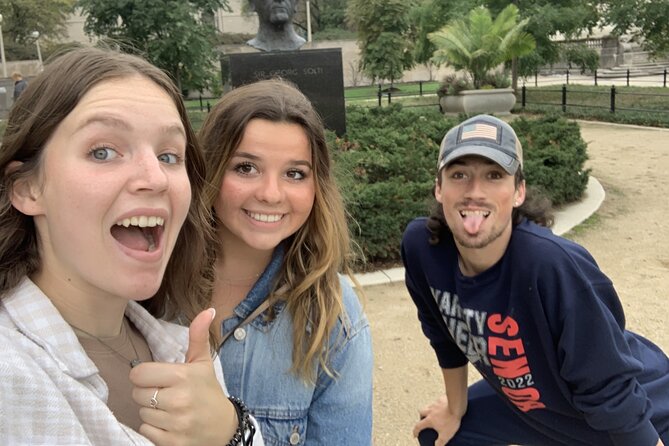
Another stop features a seated Abraham Lincoln sculpture. Lincoln is shown in a reflective pose, sitting in a chair and looking down into the distance. The work is a quieter change from the large, shiny public pieces in Millennium Park.
The sculpture was moved to Grant Park and rededicated in October 2006 in the Sir Georg Solti Garden, near Symphony Center, home of the Chicago Symphony Orchestra. That location connects the park’s monuments with Chicago’s musical life.
The route then brings you to Taft’s Fountain of the Great Lakes, completed in 1913. It was the first commission supported by the Benjamin F. Ferguson Fund, created to encourage statues and monuments along Chicago’s boulevards and public spaces.
This is a strong final stretch for anyone interested in civic art. The fountain is not just decoration. It reflects an organized effort to place sculpture in public areas where people could encounter it during an ordinary walk.
The itinerary also includes the Pritzker Military Museum & Library on Michigan Avenue. Founded in 2003, it is a nonprofit museum and research library focused on military history. Its collections include material connected with Winston Churchill and war-related sheet music.
You should check the app’s directions carefully in this part of the route. The experience is designed around outdoor movement and phone prompts, so the nearby institution may be a visual or informational stop rather than a ticketed museum visit included in your purchase.
Finishing near the School of the Art Institute

The route includes the School of the Art Institute of Chicago, founded in 1866 by 35 artists. It began as the Chicago Academy of Design, and its early growth led to a school building that opened on November 22, 1870.
This provides a neat link back to the Art Institute, where the walk began. Chicago’s art story here is not limited to large sculptures in a park. It also includes the schools and civic institutions that helped shape the city’s cultural identity.
The stated ending point is near the Fountain of the Great Lakes on East Jackson Boulevard, Chicago, at the southern end of the central park and museum area. The route does not return you to the starting point, so plan your next move from the ending location.
Public transportation is nearby, and most people can participate. Service animals are allowed. Since there is no physical guide, you should be comfortable reading directions and managing your own pace.
How the phone-based challenges affect the walk

The challenges are the heart of the experience, but they will not suit every mood. Some questions ask you to look around a site for a detail, then enter the answer to advance. That can make a familiar place feel more involving, especially for children and groups who enjoy a shared task.
The questions are also described as playful rather than scholarly. If you want long explanations about architecture and art, a museum audio guide or walking tour may give you more depth. Here, the information is short enough to keep the route moving.
Offline play is a real advantage. Once the game is ready on your phone, you do not need an internet connection to continue. That can reduce worry about signal gaps, though it does not remove every possible location issue. GPS range and app reconnection still matter.
Construction can block a path or hide a clue. When that happens, you may need to reveal a hint or use an expanded radius. That takes some of the satisfaction out of solving a challenge, but it is better than being trapped by a closed walkway.
For a group of four, I would have one person act as the main phone holder and keep everyone close at each stop. Make sure all players know the last location before moving on. That simple habit can help if one phone loses its place in the game.
Is $7.20 good value?
At $7.20 per person, this is inexpensive for a private downtown activity lasting about 95 minutes. If you are already planning to see Millennium Park and Grant Park, the game adds structure for very little money.
The value is strongest for families, friends, and independent visitors who want an activity rather than a standard sightseeing route. You get a planned path, facts about the city, and puzzles that can keep a group engaged.
The price does not include museum admission, food, transport, or a human guide. You are paying for access to the digital game. That is fair at this price, but you should not expect the personal questions, storytelling, or route adjustments that a private guide could provide.
Group discounts are available, which may make the activity even more appealing for larger parties. Since the tour is private, you do not have to match the pace of strangers.
Who should book this experience?
I would choose this game if you like self-guided sightseeing, short challenges, and the freedom to stop whenever you wish. It is also a good fit for families with older children who need a reason to examine public art instead of rushing past it.
It suits visitors who want to combine several central Chicago sights in one walk. The Art Institute, Millennium Park, Grant Park, Buckingham Fountain, and the city’s public monuments are all part of the same broad outing.
I would be cautious if you dislike phone-based directions or want every clue to work perfectly without adjustment. The route covers a lot of ground, so comfortable shoes are essential. Construction and GPS limits may force you to use a hint or expand the search area.
The experience is open 24/7, so you can choose your own start time. You can also take a break and return later. That flexibility is useful, but the lack of a human guide means you must manage the route yourself.
Should you book the Chicago Heist Exploration Game?
Book it if you want a low-cost, private way to turn a central Chicago sightseeing walk into a puzzle. The best parts are the mix of famous places and smaller art stops, the short historical notes, and the ability to play offline at your own speed.
Skip it if you want a polished guided talk, detailed art interpretation, or guaranteed smooth movement through every location. The app can be less enjoyable when construction blocks a clue or the GPS does not recognize your position.
For most independent groups, the price makes the experiment easy to justify. Wear good shoes, keep your phones ready, stay together, and treat the game as a flexible way to notice more of Chicago’s public art rather than as a substitute for a full guided tour.
FAQ
How long does the Eastside Chicago Heist Exploration Game take?
The experience lasts approximately one hour and 35 minutes.
Where does the activity start?
It starts at 111 S Michigan Ave, Chicago, IL 60603, USA.
Where does the activity end?
The stated ending point is near the Fountain of the Great Lakes on East Jackson Boulevard, Chicago, IL 60603.
Is a physical tour guide included?
No. This is a self-guided activity played through your smartphone.
Can I play without an internet connection?
Yes. The city game is designed to work offline, so an internet connection is not required to play.
Can I pause the game and continue later?
Yes. You can start at any hour, take a break whenever you like, and resume later.
What language is the game offered in?
The activity is offered in English.
Can I cancel for a full refund?
Yes, if you cancel at least 24 hours before the experience start time. Cancellations made within 24 hours are not refunded, and changes within that period are not accepted.
Just added in Chicago
- Chicago: Architecture and Engineering Marvels Walking Tour★ 5.0 · 3 reviews
- Private Downtown Chicago TV and Movie Sites Guided Walking Tour★ 4.5 · 3 reviews
- Black Heritage Tour★ 5.0 · 3 reviews
- Private SUV Transfer from Chicago Downtown to Midway airport★ 5.0 · 3 reviews
- Private Holiday City Tour★ 5.0 · 3 reviews
- BYOB Chicago River Guided History Tour★ 5.0 · 4 reviews
- Chicago 4-Hour Sightseeing Transfer by Luxury SUV★ 4.5 · 3 reviews
- Chicago, Cloud Gate, Grant Park Full-Day City Tour★ 4.0 · 4 reviews
Chicago Escape Rooms & Scavenger Hunts, compared.

The Escape Game Chicago: Epic 60-Minute Adventures in River North
Read our review →


Chinatown Chicago: Dragon Kings Quest Outdoor Escape Game
Read our review →

Browse the lists this tour appears in