
Reviewed · SELF-GUIDED TOURS
Chicago’s Storied Neighborhood: An Audio Tour
Chicago’s Hyde Park is best understood on foot, and this self-guided audio tour gives you a local voice to follow as you move from the University of Chicago Laboratory Schools toward Washington Park and the DuSable Museum of African American History. The narrator, Bill Ayers, brings personal memories and political perspective to places that can otherwise look like grand buildings on a quiet campus.
I like the freedom to stop and start whenever you wish, and I like that the VoiceMap app supplies offline audio, maps, and route data. The route also links several important Hyde Park sights in one walk. The main caution is the long stretches without narration. At roughly three miles, this may feel too far for some walkers, especially because the tour is advertised as 40 minutes to an hour but may take longer when you pause or walk slowly.
In This Review
- Key points to know before you book
- Hyde Park Through the Voice of Bill Ayers
- Starting at the Laboratory Schools
- Rockefeller Memorial Chapel and the University Setting
- Frederick C. Robie House and Architectural Context
- University of Chicago Faculties and Campus Buildings
- The Nuclear Energy Sculpture
- Washington Park Brings a Change of Pace
- The DuSable Museum of African American History
- Finishing at 1101 East Hyde Park Boulevard
- What You Get for the Price
- Who Will Like This Hyde Park Walk
- Should You Book It?
- FAQ
- How long does the Chicago’s Storied Neighborhood audio tour take?
- Where does the tour begin?
- Where does the tour end?
- Is the tour guided in person?
- Is the audio available offline?
- What is included and what must I bring?
Key points to know before you book
- Bill Ayers provides the narration, adding personal stories from a longtime professor and activist.
- The route covers about three miles, so comfortable shoes and enough time matter.
- University of Chicago landmarks lead the way, including Rockefeller Memorial Chapel and Robie House.
- The audio is not continuous, and some stretches may feel quiet or lightly explained.
- Offline maps and audio are included, useful if you do not want to depend on mobile service.
- The walk ends near 1101 East Hyde Park Boulevard, not at the starting point.
Hyde Park Through the Voice of Bill Ayers
This is not a conventional guided walk with a person waiting at the meeting point. You use the VoiceMap app on your Android or iOS phone, put in your headphones, and follow the route at your own pace.
Bill Ayers is the draw. His connection to Chicago, teaching, and activism gives the tour a personal angle rather than a simple list of dates and architectural facts. You are not just pointed toward a building and told its name. The aim is to understand how the University of Chicago and Hyde Park fit into the city’s civic and intellectual life.
That said, you should set your expectations correctly. This is an audio walk, not a campus tour with interior access. The route passes university buildings and notable landmarks, but it does not promise entry into the original university buildings. If you want a packed stream of commentary from start to finish, this may feel thin.
I would treat it as a flexible orientation walk. You get a route, a local narrator, and a set of useful landmarks. You do not get the constant attention or detailed question-and-answer time of a live guide.
A few more Chicago tours worth a look before you decide
- Medieval Torture Museum Ticket with Audio Guide and Ghost Hunting
★ 5.0 · 962 reviews - Eastside Chicago The Heist Exploration Game and Tour
★ 4.0 · 10 reviews - Chicago Self-Guided Audio Tour
★ 4.0 · 9 reviews
Starting at the Laboratory Schools
The tour begins outside the University of Chicago Laboratory Schools at 1362 East 59th Street. This is a practical starting point because it places you on the edge of the university area and gives the walk a clear address.
Before you set off, download the VoiceMap app and make sure the tour’s audio, map, and geodata are available offline. The booking includes lifetime access in English, so you are not limited to one attempt. You can pause, stop for a break, or return to the route later.
The app is designed to trigger narration at the proper points as you walk. That feature is one of the strongest reasons to choose an audio tour instead of simply downloading a podcast. You can keep your phone in your pocket and let the route guide you.
Still, bring headphones and a charged smartphone. Neither is included. You are also responsible for your own transportation, food, drinks, and any admission fees that might arise if you choose to enter places along the way.
Rockefeller Memorial Chapel and the University Setting
From the opening point, the walk passes Rockefeller Memorial Chapel. This is one of the University of Chicago’s most recognizable buildings, and it gives the route an immediate sense of scale and ceremony.
The chapel helps show the contrast that defines this part of Hyde Park. The university has an old, formal appearance in places, but the surrounding neighborhood is also a living Chicago community. The audio commentary can help you connect the buildings to the people and ideas associated with the area.
Do not expect a full interior visit here. The tour passes the chapel rather than promising admission. That distinction matters if you are choosing this walk mainly for architecture. You will see the exterior setting and hear commentary, but you should plan separately for any building access.
The university portion works best if you like moving at an easy pace and looking around between audio segments. The quieter gaps give you room to notice details, but they can also feel like dead time if you are waiting for a constant narration track.
Frederick C. Robie House and Architectural Context
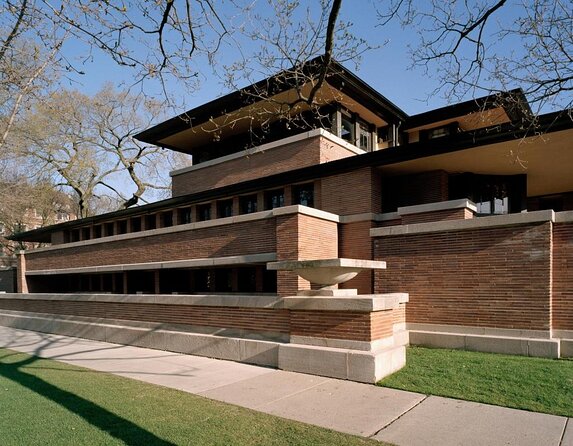
The route also passes Frederick C. Robie House, one of Hyde Park’s major architectural landmarks. Its inclusion gives the tour more weight than a simple stroll around university streets.
Robie House is especially useful as a pause point because it links Hyde Park to the work of Frank Lloyd Wright and to the broader story of modern American architecture. The supplied tour information does not promise entry, so think of this as an exterior stop unless you arrange admission separately.
Admission costs are not included. That is not necessarily a flaw, since the audio tour is built around a walking route and not a bundled museum visit. But it does affect the value calculation. If your goal is to go inside Robie House, you will need to check its separate admission arrangements and allow extra time.
I like having this landmark on the route because it gives you a clear visual reward during the university walk. Just remember that the tour’s value comes from the route and narration, not from included access to major attractions.
A different way to spend an afternoon in Chicago:
- Chicago Architecture River Cruise
★ 5.0 · 15,756 reviews - Chicago River 90-Minute Architecture Tour
★ 4.5 · 9,629 reviews - Chicago River: 1.5-Hour Guided Architecture Cruise
★ 4.8 · 8,046 reviews - Chicago: Gangsters and Ghosts Walking Tour
★ 5.0 · 7,155 reviews
University of Chicago Faculties and Campus Buildings
The walk continues past faculties and other University of Chicago buildings. This section is less about one famous sight and more about seeing how the university occupies the neighborhood.
The campus can be difficult to understand from a map alone. A self-guided route helps organize the buildings into a story, especially if you are new to Hyde Park. Ayers’ commentary adds a human layer, with personal observations that can make the academic setting feel less distant.
This is also where the tour’s limits become most noticeable. The route passes buildings rather than taking you through them, and the narration may not fill every minute. One account of the walk found the long silent stretches frustrating and expected more information about the university’s original buildings. That is fair criticism if you are hoping for a dense campus lecture.
My advice is to use these quieter moments well. Look at the architecture, check the map, take photographs, or pause the tour if you want to read a plaque. The experience gives you control, but that also means you must supply some of your own curiosity.
The Nuclear Energy Sculpture
The Nuclear Energy Sculpture is another unusual stop on the route. Its placement within a walk focused on the University of Chicago gives the tour a chance to move beyond buildings and into the scientific history connected with the area.
The sculpture is the kind of sight that benefits from commentary. Without context, you might pass it quickly. With a narrator explaining its meaning and connection to the university, it becomes a point for thinking about science, politics, public memory, and the consequences of discovery.
The supplied details do not specify how long the audio segment lasts or whether the tour pauses directly beside the sculpture. The app’s location-based design should direct you to the appropriate point, but give yourself room to stop and look before moving on.
This stop also shows why the tour is more interesting as a complete route than as a list of famous buildings. Hyde Park’s story includes education, architecture, activism, science, public art, and neighborhood life. The walk touches each of those subjects, though not always at great length.
Washington Park Brings a Change of Pace
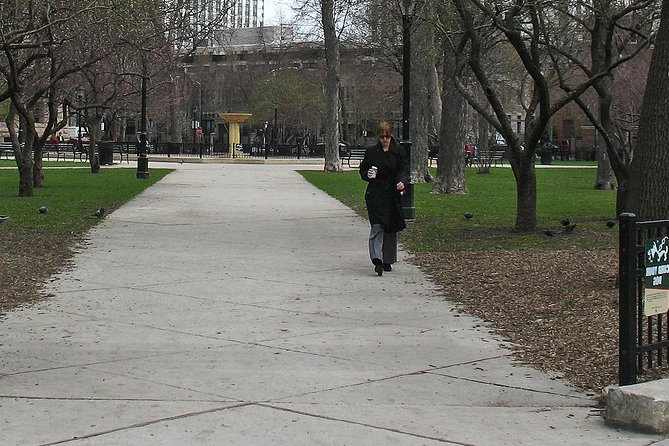
The route passes through parts of Washington Park after leaving the university area. This change of setting is welcome. The walk moves away from academic buildings and into a large public park, giving you a different view of Hyde Park.
The park section may be the most important place to manage your expectations. There is much to say about Washington Park, including its role in the city’s boulevard system and its connection to the neighborhoods around it. The route includes the park, but the available commentary may not feel extensive enough for someone who wants a full account of those subjects.
One person who completed the walk specifically wished for more information about Washington Park and the boulevard system. I agree that this is a missed opportunity. The park is not just a gap between university sights. It is part of the design and civic structure of Chicago, and a longer explanation could have made this portion stronger.
Still, Washington Park gives you a useful break from the campus setting. If you are walking on a warm day, take your time here and use the app’s pause function. The route is self-guided, so there is no group waiting for you to catch up.
The DuSable Museum of African American History
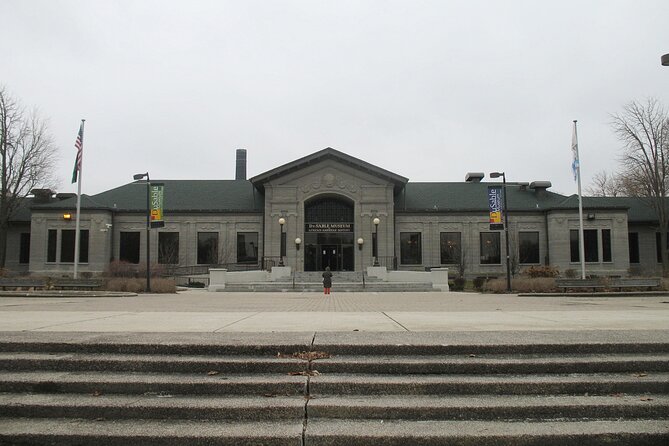
The tour passes the DuSable Museum of African American History, an important Hyde Park landmark and a valuable addition to the route. Its presence broadens the walk beyond the University of Chicago and reminds you that Hyde Park cannot be reduced to one institution.
The museum provides a natural point for further exploration. The audio tour passes by it, but admission is not included. If you want to visit inside, plan that as a separate activity and allow more time than the stated walking duration.
This is one of the places where the tour could offer more context. The museum is a major cultural institution, and a fuller explanation of its role would strengthen the final section of the walk. Even so, the stop gives you a clear suggestion for what to see next if you want to continue exploring Hyde Park after the audio ends.
I would pay attention to the route’s changing focus here. You have moved from university buildings and scientific memory toward African American history and community culture. That range is one of the walk’s better qualities.
Finishing at 1101 East Hyde Park Boulevard
The tour ends outside 1101 East Hyde Park Boulevard Apartments at 1101 East Hyde Park Boulevard. Since the start and finish are different, this is a point-to-point walk rather than a loop.
That makes the route feel more like a small neighborhood crossing, but it requires basic planning. You should know how you will leave the area after finishing. The activity is near public transportation, and the end point has a specific address, so you can check your onward route before setting out.
The supplied feedback puts the walking distance at about three miles. The official duration is listed as approximately 40 minutes to one hour, but your actual time will depend on your pace, stops, photographs, and pauses in the app. An older walker found three miles too much, so do not judge the route by the short time estimate alone.
If you have limited mobility or simply dislike long city walks, you may find the distance and quiet sections tiring. The information says most people can participate, but that does not mean the route is suitable for every walking ability.
What You Get for the Price
No price is provided here, so I cannot judge the exact cost. The useful question is what kind of value this format offers.
You receive lifetime access to the English tour, plus the VoiceMap app, offline audio, maps, and geodata. That is a better deal for someone who wants to explore independently or repeat the route later. You are not tied to a scheduled departure, and only your own group participates.
The value is weaker if you want a highly detailed, nonstop presentation. Some of the route is quiet, and the tour does not include transportation, food, drinks, headphones, or admission fees. You are paying for the guided route and Bill Ayers’ perspective, not for a full package of Hyde Park attractions.
I would compare the cost with a short live walking tour. If the audio tour is priced modestly, the flexibility and lifetime access make sense. If it is priced close to a detailed live tour, you should think carefully about whether the personal narration is more important to you than constant commentary and the chance to ask questions.
Who Will Like This Hyde Park Walk
I would recommend this experience most strongly to people who enjoy setting their own pace and want a broad introduction to Hyde Park. It suits independent walkers, repeat visitors to Chicago, and anyone interested in the connection between universities, public art, science, architecture, and neighborhood culture.
It is also a good fit if Bill Ayers’ personal voice interests you. His background as a professor and activist is central to the character of the tour. You get an insider’s angle rather than a neutral recording made for a generic sightseeing route.
You may want a different option if you need a short, tightly packed walk. The three-mile route and silent stretches can make the experience feel longer than expected. It is also not the best match if your priority is entering Robie House, Rockefeller Memorial Chapel, university buildings, or the DuSable Museum.
Bring comfortable shoes, headphones, water, and a fully charged phone. Check the start and finish addresses before leaving. If you need a rest, pause the audio rather than rushing to keep up with an imagined schedule.
Should You Book It?
Book this tour if you want a flexible Hyde Park orientation with Bill Ayers as your guide and you are comfortable filling some quiet stretches with your own looking and thinking. The strongest features are the personal narration, the location-based app, and the route linking university landmarks with Washington Park and the DuSable Museum.
Skip it if you expect a detailed lecture at every stop or if three miles is a concern. The tour has a worthwhile idea at its core, but its value depends heavily on your expectations. Think of it as a thoughtful audio walk with selected commentary, not a complete history of Hyde Park.
FAQ
How long does the Chicago’s Storied Neighborhood audio tour take?
The tour takes approximately 40 minutes to one hour. Your actual time may be longer if you walk slowly, pause the audio, stop for photographs, or spend time at the landmarks.
Where does the tour begin?
It begins outside the University of Chicago Laboratory Schools at 1362 East 59th Street, Chicago, Illinois 60637.
Where does the tour end?
The tour ends outside 1101 East Hyde Park Boulevard Apartments at 1101 East Hyde Park Boulevard, Chicago, Illinois 60615.
Is the tour guided in person?
No. This is a private, self-guided audio activity using the VoiceMap app. Only your group participates.
Is the audio available offline?
Yes. The booking includes offline access to the audio, maps, and geodata through the VoiceMap app for Android and iOS.
What is included and what must I bring?
You receive lifetime access to the English tour and the VoiceMap app. You must bring your own smartphone and headphones. Transportation, food, drinks, and admission fees are not included.
Just added in Chicago
- Chicago: Architecture and Engineering Marvels Walking Tour★ 5.0 · 3 reviews
- Private Downtown Chicago TV and Movie Sites Guided Walking Tour★ 4.5 · 3 reviews
- Black Heritage Tour★ 5.0 · 3 reviews
- Private SUV Transfer from Chicago Downtown to Midway airport★ 5.0 · 3 reviews
- Private Holiday City Tour★ 5.0 · 3 reviews
- BYOB Chicago River Guided History Tour★ 5.0 · 4 reviews
- Chicago 4-Hour Sightseeing Transfer by Luxury SUV★ 4.5 · 3 reviews
- Chicago, Cloud Gate, Grant Park Full-Day City Tour★ 4.0 · 4 reviews
Self-Guided Tours, compared.
Eastside Chicago The Heist Exploration Game and Tour
Read our review →
Chicago’s Gold Coast Hidden History: A Self-Guided Audio Walk
Read our review →

Browse the lists this tour appears in