
Reviewed · CHICAGO LOOP & RIVER NORTH TOURS
Self-Guided Chicago Loop Tour Explore the City at Your Own Pace
Chicago’s Loop is best understood on foot, where steel skyscrapers, public art, river bridges, grand theaters, and old trading halls crowd into a compact downtown. This self-guided route links the city’s major sights, from the reflective Bean and Calder’s red Flamingo to the Chicago Board of Trade and Willis Tower.
I especially like the offline access, since you can listen without cell service, and the GPS-triggered audio, which starts information as you reach each place. I also like the freedom to pause for photos, step into buildings, or stretch the advertised two-hour walk into four or five hours. The main tradeoff is that you must bring your own charged smartphone, download the app and tour before setting out, and manage the route yourself.
In This Review
- Key points to know before you go
- Why this Loop walk works well for first-time visitors
- Starting at DuSable Bridge and the Chicago River
- Millennium Park, from Buckingham Fountain to Cloud Gate
- Calder, Picasso, and the Loop’s public art
- The Cultural Center and Chicago’s grand interiors
- The Rookery and Chicago’s early skyscraper story
- The Chicago Theatre and Harold Washington Library
- Ending near Willis Tower and what the timing really means
- How to use the app without wasting time
- Who will get the most from this $9.99 tour
- Should you book this Chicago Loop walk?
- FAQ
- Where does the self-guided Chicago Loop tour begin?
- Where does the tour end?
- How long does the tour take?
- Is the tour guided by a person?
- Does the tour work without cell service?
- What language is available?
- Do I need to bring my own phone?
- Are admission tickets included?
- Can I cancel for a full refund?
Key points to know before you go
- GPS audio keeps you moving: Commentary plays based on your location, so you do not need to keep stopping to search for the next track.
- The route covers major Loop icons: You’ll see Buckingham Fountain, Millennium Park, the Chicago Cultural Center, the Rookery, the Picasso, and more.
- The $9.99 price is modest: It costs less than a conventional guided walk, while access remains available for unlimited use.
- You can take far longer than two hours: The planned timing is about two to two and a half hours, but the format leaves room for photos, interiors, and repeat listening.
- Download before arrival: The tour works offline after setup, but you need the Drives & Detours app, redemption code, and your own phone.
- The finish is near Willis Tower: The route begins at DuSable Bridge and ends by one of Chicago’s best-known skyscrapers.
Why this Loop walk works well for first-time visitors
This is a useful way to get your bearings fast in central Chicago without committing to a group or fixed departure. You begin at DuSable Bridge, near 333 Michigan Avenue, then work through a remarkable concentration of public art and architecture before reaching Willis Tower at 233 South Wacker Drive.
The route is private in the sense that only your group takes part, but there is no live guide walking beside you. That distinction matters. You gain control over the pace, yet you also need to watch the map, listen for instructions, and decide when to stop.
At $9.99 per person, the value is strongest if you want a broad introduction rather than a deep architectural tour of one building. A normal sightseeing walk can rush you past the details. Here, you can pause the commentary while you take pictures, then replay information later because access does not expire.
The planned time is about two hours to two and a half hours. In practice, you should treat that as walking and listening time, not a full visit to every attraction. One person using the tour spent four or five hours by adding photo stops and extra exploring. That is exactly how I would use it.
More of the Loop and River North:
- Chicago Loop District Food Tour with Deep Dish & Beef Sandwich
★ 5.0 · 870 reviews - Chicago Architecture Tour: Underground Pedway and the Loop
★ 5.0 · 388 reviews - The Escape Game Chicago: Epic 60-Minute Adventures in River North
★ 5.0 · 332 reviews
Starting at DuSable Bridge and the Chicago River
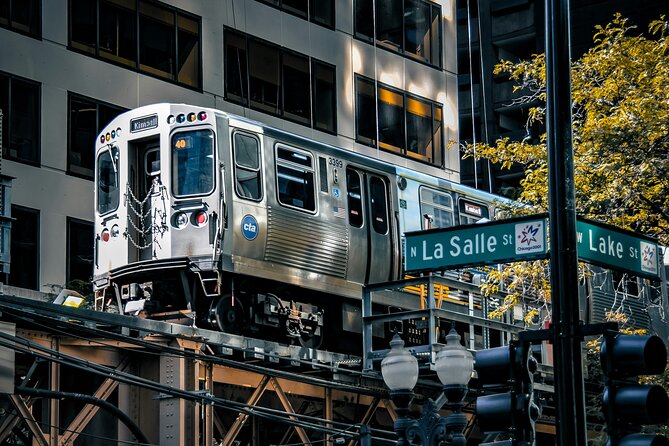
The route starts at the DuSable Bridge, the double-deck, double-leaf bascule bridge carrying Michigan Avenue across the Chicago River. Its ornate towers show scenes connected with Chicago’s past and honor Jean Baptiste Point DuSable, the city’s founder.
This is a fine opening point because the river helps you read the city. Chicago’s north and south sides meet here, while the bridge, buildings, and water frame the downtown story. The bridgehouse nearby offers exhibits about the river and Chicago’s growth, and you can climb inside a working bridgehouse to see the gears that lift the bridge.
That bridgehouse visit may take extra time beyond the five-minute audio stop. Check your timing and opening access on the day, since the route includes the building but does not promise admission as part of the $9.99 fee.
The Vietnam Veterans Memorial Plaza follows as a quieter riverside pause. Polished granite walls reflect names and memories, giving you a moment of stillness before the Loop’s louder streets and larger monuments take over.
Millennium Park, from Buckingham Fountain to Cloud Gate
The walk brings you toward several of Chicago’s best-known outdoor sights. At Clarence F. Buckingham Fountain, water rises as high as 150 feet in the central jet, with choreographed displays set against the skyline. The five-minute stop is enough for an introduction, but not necessarily enough for photographs from every angle.
The fountain was inspired by Versailles and is among the world’s largest. That grand scale can feel almost theatrical, especially with the skyline behind it. Since admission is free, you can return later if the fountain becomes a favorite.
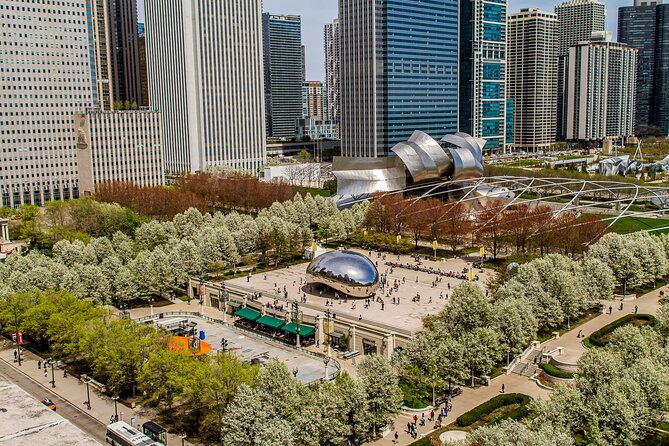
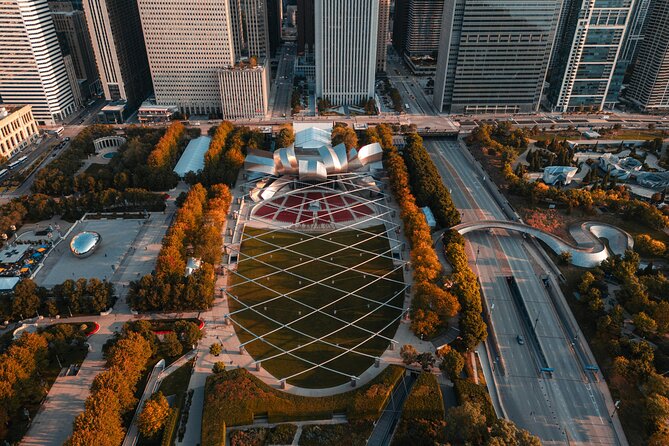
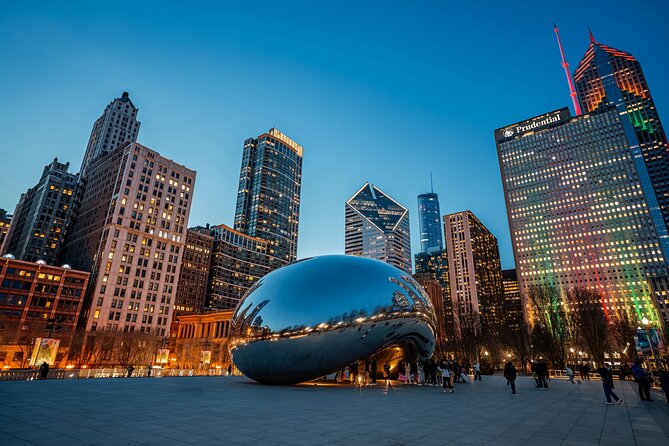
Millennium Park then turns the walk into an open-air art tour. Cloud Gate, better known as the Bean, reflects you, the buildings, and the sky in one polished surface. Walk beneath it if space allows, and look at how the sculpture bends the skyline into strange shapes.
The five-minute timing here is especially brief. Crowds, pictures, and the simple pleasure of looking at the reflections can easily stretch the stop. The tour’s flexible access helps, since you can pause the audio and resume it later.
Crown Fountain offers a completely different mood. Two glass-block towers show video portraits and spray water in summer. It is playful and interactive, though the water feature is seasonal, so do not plan on it as a year-round experience.
Nearby, Frank Gehry’s Jay Pritzker Pavilion uses sweeping steel ribbons to frame an outdoor concert venue. Its sound system and dramatic structure make it worth seeing even when no performance is taking place. The route also includes the Millennium Monument, a semicircular recreation of a 1917 colonnade that honors Chicago’s founders.
Calder, Picasso, and the Loop’s public art
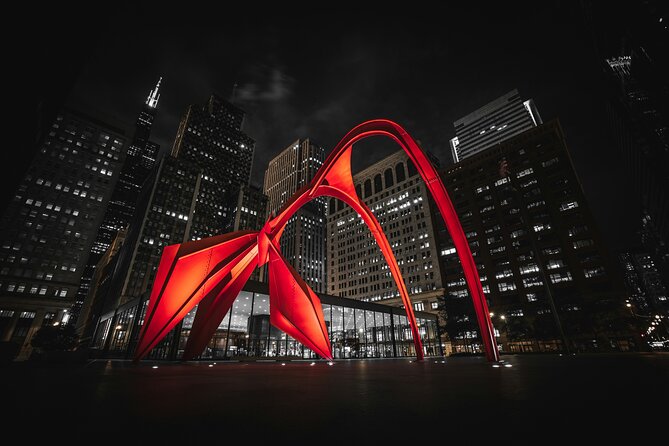
Alexander Calder’s Flamingo brings a huge red form into the city’s steel-and-glass setting. Its broad curves and strong color make it easy to spot, and the contrast is part of the fun. You do not need an art background to appreciate the way it changes the feel of the surrounding plaza.
The Picasso comes later as another public artwork that refuses a single meaning. Pablo Picasso gave the abstract steel sculpture to Chicago, and its shape invites you to decide what you see. It is a quick stop, but one of the route’s most memorable reminders that art in Chicago is not confined to museums.
Miro’s Chicago adds a whimsical Joan Miró sculpture to the Loop. Its abstract form and playful color give the city another visual break from office towers and traffic. These outdoor works are a strong reason to choose this route over a walk focused only on historic buildings.
The tour also begins with an unnamed museum stop describing the Art Institute of Chicago, home to major works including American Gothic and a wide collection spanning centuries and continents. The Beaux-Arts building is worth knowing about, but the provided route details do not list a timed admission stop or ticket inclusion. Think of it as an important nearby landmark or possible add-on, not part of the $9.99 admission.
A few more Chicago tours worth a look before you decide
- Medieval Torture Museum Ticket with Audio Guide and Ghost Hunting
★ 5.0 · 962 reviews - Eastside Chicago The Heist Exploration Game and Tour
★ 4.0 · 10 reviews - Chicago Self-Guided Audio Tour
★ 4.0 · 9 reviews - Chicago’s Gold Coast Hidden History: A Self-Guided Audio Walk
★ 4.5 · 7 reviews
The Cultural Center and Chicago’s grand interiors
The Chicago Cultural Center occupies a former library and is free to enter. Its stained-glass domes are the main draw, but art displays and performances can make the building feel like more than a quick photo stop.
The audio stop is listed at five minutes, which works for a first look. If the building is open when you pass, I would allow extra time for the interior. The contrast is pleasant: you move from public art and traffic into a calm civic building with carefully made architectural details.
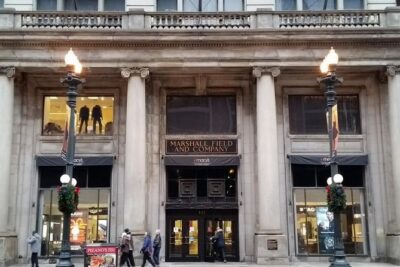
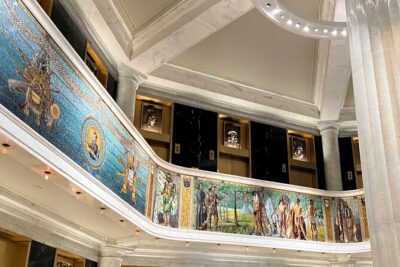
Another unnamed stop describes a 1895 Chicago School high-rise with ornate terra cotta, a luminous interior rotunda, and mosaics telling stories of early explorers. The description points to the city’s early skyscraper tradition, when buildings had to solve new problems of height, light, structure, and decoration.
Because the exact name and access details are not provided, use the audio as your guide and do not count on a full interior visit. Some downtown interiors have limited public hours or entry rules. The tour is at its best when you stay flexible.
The Rookery and Chicago’s early skyscraper story

The Rookery Building is one of the oldest surviving high-rises in Chicago. Its design mixes Romanesque features with early skyscraper ideas, while the light court was redesigned by Frank Lloyd Wright.
This is one of the route’s strongest architectural stops. The building helps explain why Chicago matters to modern city design. Its interior light court is more rewarding than a quick look at the outside, so give yourself time if you find the building open.
The audio stop is again listed at five minutes. That is enough to point out the main features, but I would not hurry through the details. Listen once, take a few photographs, and replay the commentary if you want to connect Wright’s changes with the older structure.
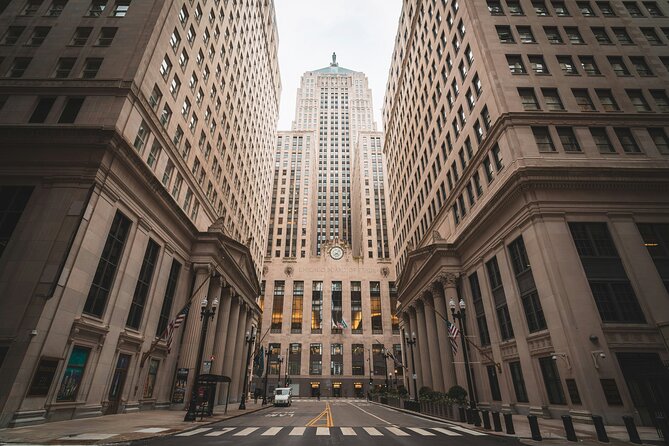
The Chicago Board of Trade Building offers another view of the city’s working past. Its Art Deco tower rises above the former financial district, with a statue of Ceres, the goddess of agriculture, at the top. The lobby gives you a glimpse of Chicago’s trading legacy.
Together, these buildings make the walk more than a checklist of famous objects. You see Chicago as a place shaped by commerce, engineering, art, and civic ambition.
The Chicago Theatre and Harold Washington Library
The Chicago Theatre brings a change of scale and mood. Its marquee is instantly recognizable, while the inside uses a lavish French Baroque design dating from 1921.
The route does not include a performance or a promised theater admission. You can still appreciate the facade and the role the building plays in the city’s entertainment story. If a performance or interior tour is part of your plans, that would be a separate purchase and time commitment.
The Harold Washington Library Center is another useful stop, especially if you want a quiet break. Its glass atrium and Winter Garden offer a calm public interior above the busy streets. The five-minute audio segment introduces the building, but you can stay longer if you want to see the upper spaces.
These stops also show the range of the Loop. In a short walk, you move from a theater marquee to a public library, from a trading tower to a sculpture by Picasso.
Ending near Willis Tower and what the timing really means
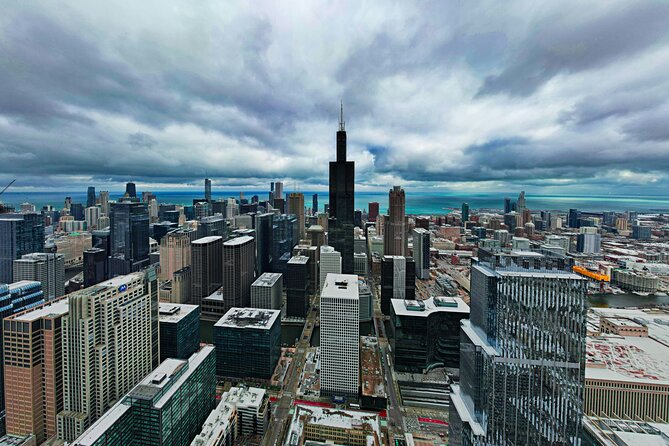
The route ends at Willis Tower, once the world’s tallest building. Its Skydeck on the 103rd floor offers wide city views, while The Ledge provides a glass-floor experience.
Skydeck admission is not included in the $9.99 tour price. That is important when you compare costs. The walking tour gets you to the building and gives context, but you need a separate ticket if you want to go up.
The end point is convenient for downtown plans. Willis Tower is across the river from Chicago Union Station, near South Wacker Street, West Adams Street, and West Jackson Boulevard. It also makes a clear stopping point if you are continuing by train or heading elsewhere in the city.
The stated opening window for this experience is 8:00 a.m. to 8:00 p.m., Monday through Sunday, for the dates provided. Since the walk is outdoors and several buildings may have their own hours, daytime is the simplest choice.
How to use the app without wasting time
Download the Drives & Detours app and the tour before you arrive at DuSable Bridge. You will need your own smartphone, and the tour is offered in English.
The GPS audio should play automatically as you reach the stops. Once the content is downloaded, no cell service is required. That is helpful in a tall-building district where signal can be unreliable, but you still need enough battery for the walk and audio.
The map is meant to be easy to follow, yet self-guided walks always require a little attention. Keep the phone accessible, confirm that the audio is playing, and pause when you enter a building or stop for pictures.
You can use the tour any day or time after purchase, and access does not expire. That makes it useful for a second attempt if rain, a closed building, or a crowded park changes your plans.
Free cancellation is available if you cancel at least 24 hours before the start time. Inside that window, the payment is not refunded and changes are not accepted.
Who will get the most from this $9.99 tour
I would choose this experience if you want a low-cost orientation to the Loop and prefer to set your own rhythm. It suits independent visitors, couples, families who need photo breaks, and anyone who dislikes joining a fixed group.
It is also a good fit if you like replaying information. One useful feature is the ability to listen again for many days, rather than losing the commentary once the walk ends.
You may want something else if you expect a live guide, detailed answers to spontaneous questions, or guaranteed entry into every building described. The short stop times also favor a broad overview instead of a slow study of each landmark.
The small set of ratings available is uniformly positive, with particular praise for the easy map, well-timed GPS commentary, flexibility, and the ability to spend four or five hours instead of rushing through in two. Those strengths are real, but they depend on your willingness to operate the app and choose your own stops.
Should you book this Chicago Loop walk?
Book it if you want an inexpensive, flexible route through Chicago’s best-known downtown sights, especially Millennium Park, the river bridges, public art, the Rookery, and Willis Tower. At $9.99, unlimited access and offline audio make the price easy to justify.
Skip it if you want a person leading the way or if your main goal is a full interior tour of the Art Institute, Rookery, bridgehouse, or Skydeck. For most independent visitors, the smart approach is to use this as your Loop framework, then add paid admissions and extra time wherever a building catches your interest.
FAQ
Where does the self-guided Chicago Loop tour begin?
It begins at DuSable Bridge, at 333 Michigan Avenue, Chicago, Illinois 60601.
Where does the tour end?
The tour ends at Willis Tower, at 233 South Wacker Drive, Chicago, Illinois 60606.
How long does the tour take?
The planned duration is approximately two hours to two hours and 30 minutes. You can take longer because the tour has flexible access and lets you pause for photos and extra exploring.
Is the tour guided by a person?
No. It is a self-guided audio tour that uses GPS-triggered commentary through the Drives & Detours app.
Does the tour work without cell service?
Yes. It works entirely offline after you download the app and tour.
What language is available?
The audio tour is offered in English.
Do I need to bring my own phone?
Yes. A smartphone is not included, so you need to bring your own device and download the tour ahead of time.
Are admission tickets included?
The listed outdoor stops have free admission, but the tour price does not include separate admission for attractions such as the Art Institute of Chicago or the Willis Tower Skydeck.
Can I cancel for a full refund?
Yes, if you cancel at least 24 hours before the experience start time. Cancellations or changes made within 24 hours are not accepted and are not refunded.
Just added in Chicago
- Chicago’s Luxury Minibus City Sightseeing Tour★ 3.5 · 3 reviews
- Chicago White Sox Baseball Game Ticket at Guaranteed Rate Field★ 4.5 · 3 reviews
- City Cruises Chicago: Signature Brunch Cruise on Lake Michigan★ 4.5 · 3 reviews
- Private Transfer from Chicago Airport (ORD)★ 3.5 · 3 reviews
- Michigan Avenue Rendezvous Walking Tour with Smartphone App★ 3.2 · 3 reviews
- Airport transfer between Chicago O’Hare and Milwaukee★ 4.7 · 3 reviews
- Harry Potter Shop Chicago: Confectionary Collection★ 4.5 · 3 reviews
- Chicago Haunted Ghost Tour GPS Self-Guided Walking Tour★ 4.5 · 3 reviews
Chicago Loop & River North Tours, compared.

Chicago Loop District Food Tour with Deep Dish & Beef Sandwich
Read our review →
Chicago Architecture Tour: Underground Pedway and the Loop
Read our review →
The Escape Game Chicago: Epic 60-Minute Adventures in River North
Read our review →

Walking Tour: Historic Chicago Pubs in River North and the Loop
Read our review →
Chicago Loop: Art, Skyscrapers, Millennium Park & “The Bean”
Read our review →Browse the lists this tour appears in